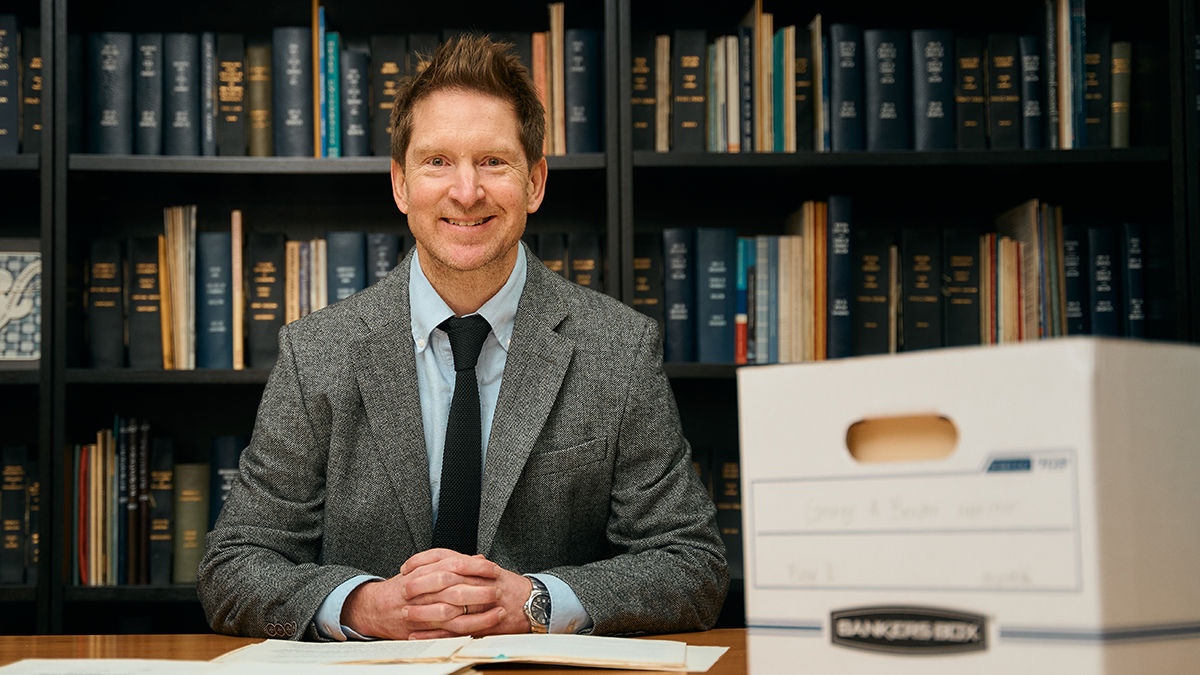
The fellowship will fuel Richert’s forthcoming book, Chain Reaction, investigating how pharmacy became big business
Three years ago, Lucas Richert stumbled across a document that changed the way he looked at pharmacy. As the George Urdang Chair in the History of Pharmacy, Richert is both a professor of pharmacy at the University of Wisconsin–Madison School of Pharmacy and executive director of the American Institute of the History of Pharmacy (AIHP). It was in the institute’s files that he discovered a survey from the 1960s that sparked his interest. The questionnaire had been sent to physicians around the nation, asking for their opinions on pharmacists.
“The results were wild,” Richert recalls. So wild, in fact, that they inspired him to start writing what would become his fourth book, Chain Reaction: The Rise of Big Pharmacy, Corporate Health, and American Capitalism.
“One of the really interesting central questions, for me, is how pharmacies have balanced the role between being places of healing and of retail commerce.”
–Lucas Richert
Now, years into his research, Richert has earned a Haas Fellowship, one of the Beckman Center for the History of Chemistry’s prestigious fellowships at the Science History Institute in Philadelphia to delve deeper for his book. As one of 12 short-term fellows selected from around the globe, he’ll spend one month exploring the Science History Institute’s treasure trove of original documents, oral histories, corporate archives, marketing materials, and much more.
“By the time the month is done, I want to have written a fair amount and built relationships with other scholars, of course,” Richert says. “But I also want to have found human stories from those archives. I want to tell human stories about pharmacy that haven’t been told before.”
Candy salesmen and healthcare pros
The idea behind Chain Reaction — following Cannabis: Global Histories in 2021 and Strange Trips and Break on Through in 2019 — began to form as Richert paged through the results of that 1960s survey in AIHP’s files.
Some doctors, when asked their thoughts on pharmacists, said, “All they do is sell candy and tobacco,” Richert remembers. “But some of them were saying, by contrast, that pharmacists were extremely important in protecting the safety of patients and were doing good healthcare work. It just blew my mind.”
The contrast was so stark, Richert couldn’t help but ask more questions about what this survey revealed. Why was the archetypal pharmacist of the 1960s denigrated as a candy salesman by some doctors and held up as a valuable part of healthcare by others? What did that say about pharmacy as an industry, and how has it changed over the decades?
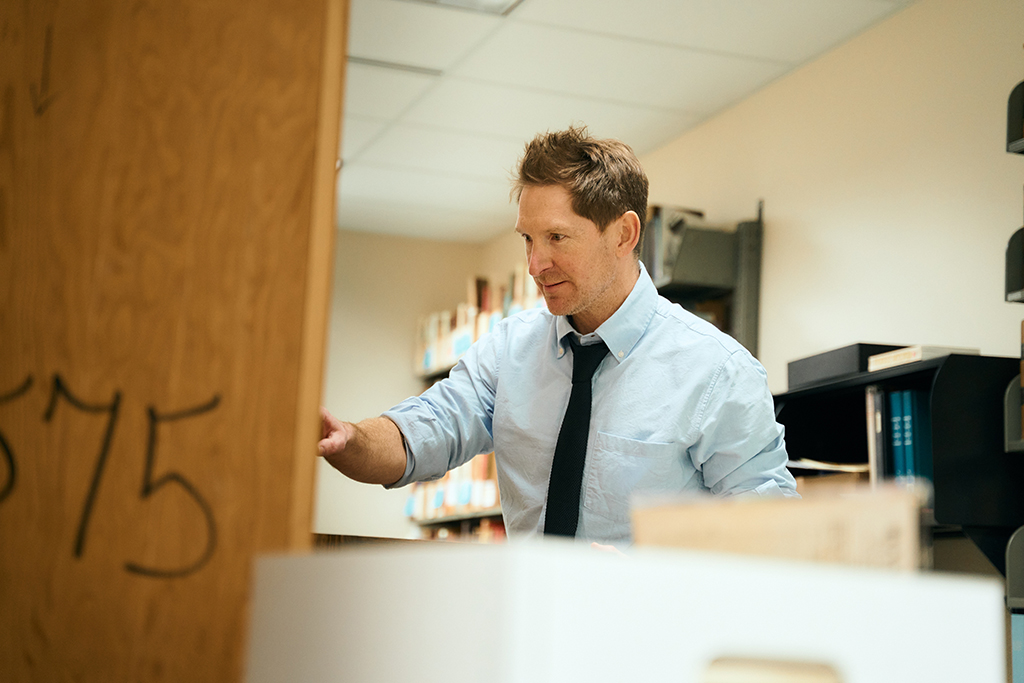
Historians, Richert realized, hadn’t fully explored this story — and its larger implications.
“When we think about pharmacy after World War II, it’s deeply embedded into the growth of the country, and yet we haven’t unpacked it,” he says. “I started to think, ‘I need to write this book.’”
As he began his research, Richert widened his scope, beginning in the American pharmacies of the 1940s, when locally owned drugstores were far more prominent across the country (and, yes, often also sold candy and tobacco). He traced the evolution of pharmacies from small, community spaces into large corporate chains. And as he did, the questions for his book to tackle widened: What does the change in pharmacy say about healthcare at large? What does it say about consumer culture, business, and capitalism in the United States?
As a Beckman Fellow, Richert will have complete access to the Science History Institute’s immense collection of trade literature and materials. And he will also have the chance to interact with the other fellows researching alongside him. The fellowship will include weekly seminars, and Richert hopes the wide breadth of research backgrounds will spark vibrant discussions that further help steer the book.
“How do we use the pharmacy as a lens to explore American healthcare?” Richert says of the questions he intends for his book to answer. “One of the really interesting central questions, for me, is how pharmacies have balanced the role between being places of healing and of retail commerce.”
More than history
Richert quickly realized that his book wasn’t only a history, but a new way to examine healthcare’s most pressing problems today.
The 2020 COVID-19 pandemic highlighted the pharmacist’s role as a frontline provider, while simultaneously calling into question who has access to that care. Those who live in healthcare deserts, or whose local pharmacies are closing, are often unable to benefit from the work of pharmacy. At the same time, pharmacists remain the most accessible healthcare professionals, and the development of new forms of pharmacy like telehealth and specialty pharmacy — which look vastly different from the community drugstore of the 1950s — have changed the conversation around what patient care looks like.
“One of the things that I’m connecting in this book for the first time is that social and cultural history with health and business history to create a new synthesis, a new understanding of both the pharmacy and the drugstore.”
–Lucas Richert
“My book is going to situate the pharmacist within a much broader story of service, of expertise, and of community trust beyond just this most recent pandemic,” Richert says. “Pharmacists today are struggling with issues like corporate consolidation, closures, staffing pressures, occupational fatigue, and tough choices about balancing patient care and the realities of business.”
He points to the recent closures of multiple Walgreens stores as just one example of industry issues with wide-reaching consequences. Beyond the impact on pharmacists and the industry, those closures can create pharmacy deserts, depriving patients of access to care.
“These issues have deep historical roots,” he says. “Drugstores themselves have really been a cornerstone of civil society. One of the things that I’m connecting in this book for the first time is that social and cultural history with health and business history to create a new synthesis, a new understanding of both the pharmacy and the drugstore.”
Nationally renowned for his trailblazing work on therapeutic psychoactive substances, Hutson spent nearly 40 years at the School of Pharmacy.

A School of Pharmacy study explores what OpenEvidence can get wrong about medications, including a dangerously high drug dose and misread research.