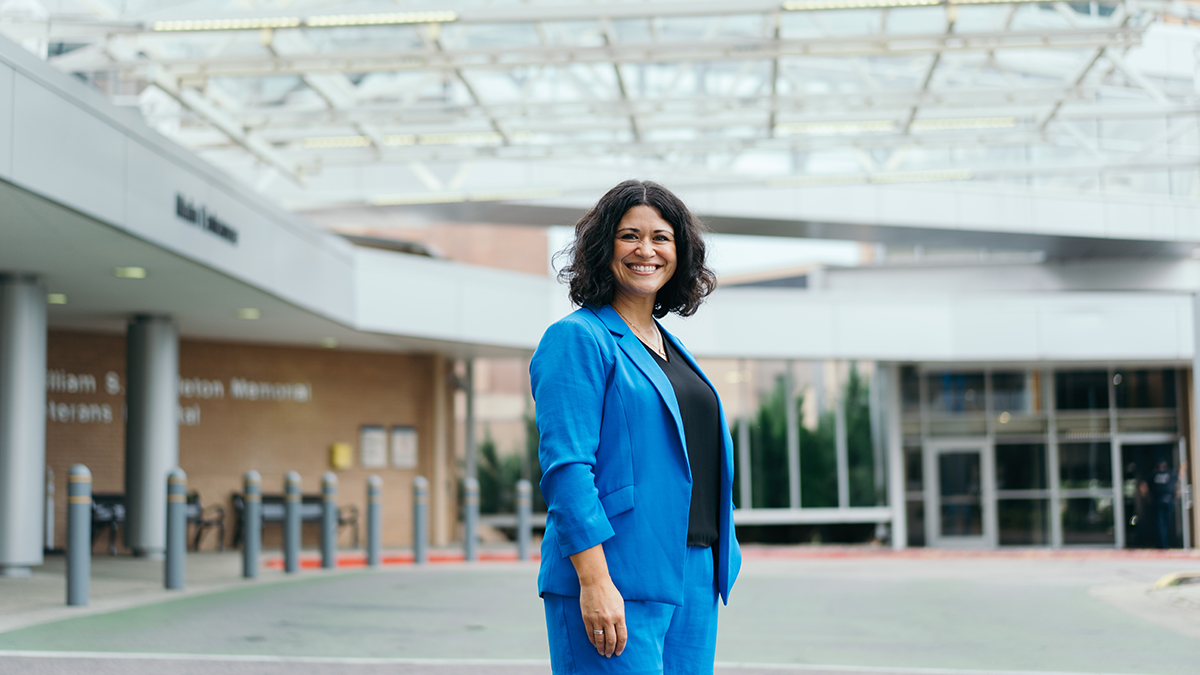
A longtime leader at the Madison VA, alum Maria Wopat shares what she’s learned about leadership, mentorship, and work-life balance
When the William S. Middleton Memorial Veterans Hospital was identified as having higher-than-expected drug spending, Maria Wopat (PharmD ’10) knew that it wasn’t due to the pharmacy’s procurement practices — those were sound.
“We were higher prescribers for certain medication classes,” she says. “I needed to reduce our spending, knowing we had good procurement practices and a formulary team that properly adjudicates authorizations.”
Instead, she spent two years getting to know the service chiefs who wrote the prescriptions, building partnerships to optimize prescribing practices to lower costs while providing evidence-based care.
“It’s important to have partnerships with services so they understand the impact of prescribing a specific injectable, for example,” she says.
“I continue to find that good communication is at the heart of so much — that’s always been a throughline in my career.”
–Maria Wopat
That’s just one example of how Wopat has leveraged her experience and expertise to make a broad impact at the Madison VA — where the pharmacy system is large and complex, with services including inpatient care, outpatient care, and ambulatory care clinics. The VA has pharmacists within almost every clinic, and each inpatient care team has its own pharmacist. Strong leaders, pharmacists, and technicians are critical to smooth operations.
Wopat began working at the VA in 2012 as a frontline clinical pharmacy specialist and tobacco cessation coordinator, after spending a year as a PGY1 resident and a second as a PGY2 resident. Wopat then became a clinical pharmacy specialist as part of a Patient Aligned Care Team (PACT). Now, Wopat holds a dual role as medication use strategy supervisor and PGY1 pharmacy residency program director.
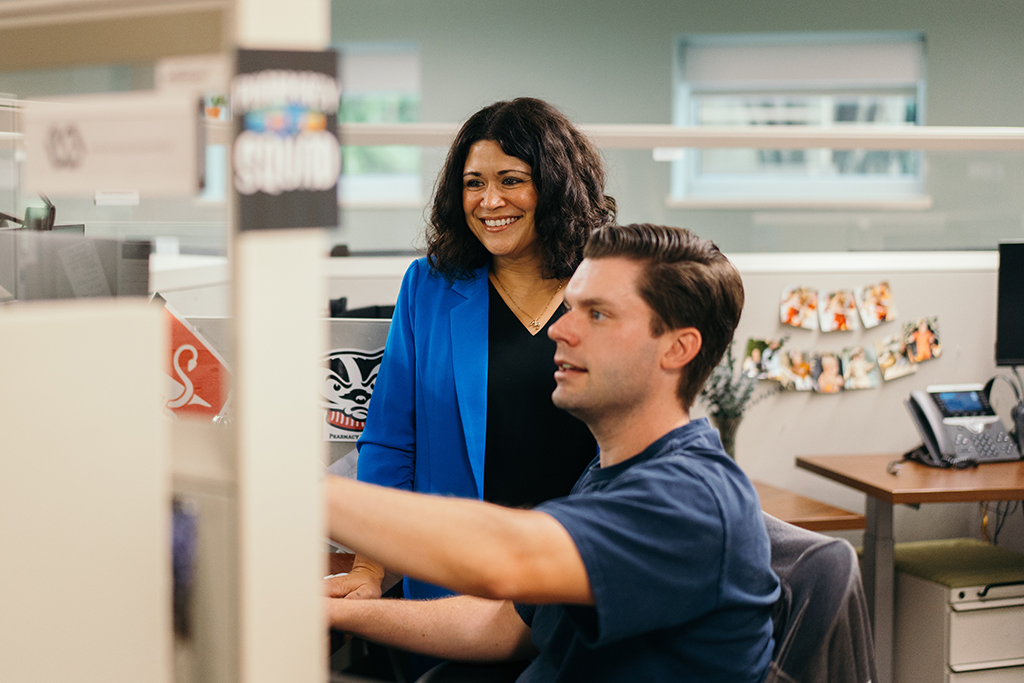
And through it all, she’s remained a resource for both the School of Pharmacy and its alumni network, serving as a preceptor, guest lecturer, frequent participant in discussion panels for career development, and longtime member of the Pharmacy Alumni Association Board.
And her impact hasn’t gone unnoticed: She was recognized by the UW–Madison Pharmacy Alumni Association as the 2022 Young Alumnus of the Year, was honored as an inaugural Pharmacy Society of Wisconsin (PSW) fellow in 2025, received the PSW Distinguished Young Pharmacist of the Year award in 2016, and was recently elected onto the PSW Board of Directors as director-at-large.
“I continue to find that good communication is at the heart of so much — that’s always been a throughline in my career,” she says. “I operate from a place of compassion, remembering we’re all still people, and work is a huge part of our lives. I lean into my values to take care of my people, so they can take care of veterans. I want to make sure we can get as much done together as possible.”
What’s unique about pharmacy in the VA Health System and your role within it?
The pharmacy system is complex and includes budget management and a formulary that is dictated from the national level, and it’s my job locally to enforce it. My role requires good relationships in and outside pharmacy.
When I’m making hard budget decisions, I aim to use taxpayer dollars judiciously.
As director of the PGY1 residency program, how do you develop emerging leaders?
Our partnership with UW–Madison is critical to our continued success. We’re still attracting and matching with great candidates, which speaks to our partnership with UW–Madison and strong clinical preceptors, with a strong, 44-year legacy that helps us keep attracting good residents.
We aim to provide residents with a good clinical foundation that will empower them to be future leaders, so we attract people who want to precept or take on more formal teaching roles going forward. We offer leadership opportunities, locally at Madison VA, in partnership with national offices, and with the School of Pharmacy, and we’re still integrated into the School’s Pharmacotherapy Lab.
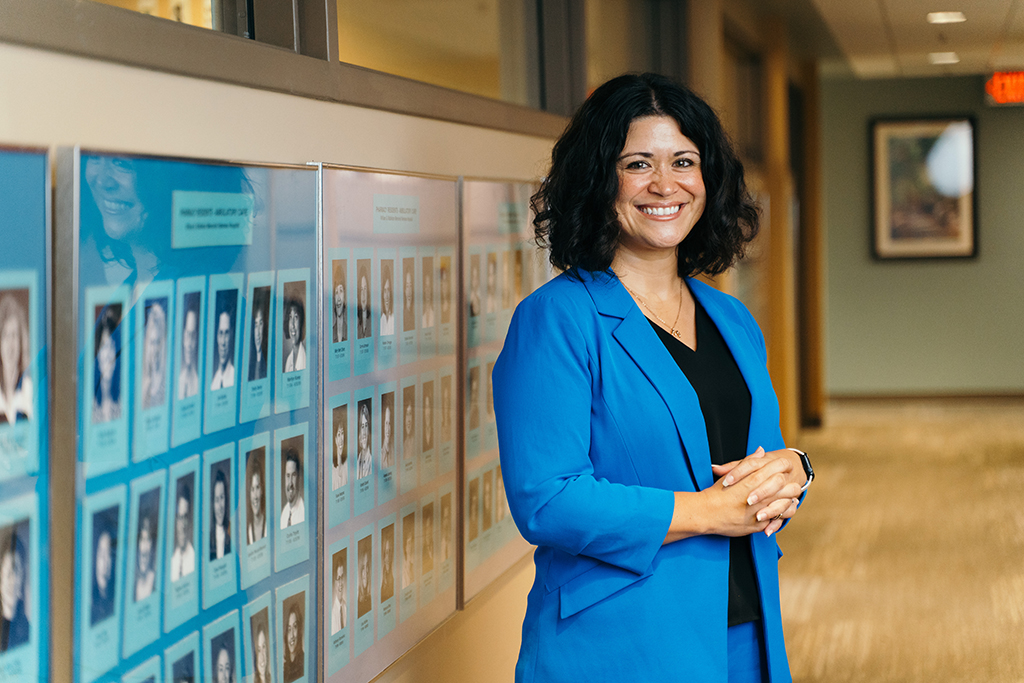
We talk about work/life integration, and it’s never going to be perfect, but we encourage residency to be a time to try to find your balance so you can take what you learn and apply that to your career, moving forward. It’s a good time to figure out what works best for you and your family and do what’s best for you and your work.
I’ve had to practice that myself. I have a sixth grader who’s a sports fanatic and twins going into third grade, who also have many activities. I’m on the Working for Kids board for our school, which is similar to a PTO, and I support all their sports and activities.
I love the residency part of my job because it mimics a school year. I take time to pause and reflect on what I want to do differently for the residency program, and also personally. I try to do that multiple times a year.
My mentor, Professor Beth Martin (BS ’90, MS ’03, PhD ’06), has always reminded me to take care of myself and that family comes first. No matter what I do, I keep that at the forefront of my mind. She relates to the busyness of balancing work and young kids.
What qualities set apart new residents and practitioners as leaders in the making?
They need to learn great communication and develop emotional intelligence, because you need to be able to hear and support the people around you — preceptors, other interdisciplinary team members, and patients. It’s important to connect with patients, to help them understand why you want them to make a medication change.
Being able to work with others, understand where they’re coming from, and manage conflict is important.
Their capacity to build relationships is also critical. It’s a time investment when you’re in a new leadership role, and it can feel like extra work until you know your people. My people know I support them, so even in conflict, they know I’m bringing things to them to get something done or resolve an issue, but they know we are starting together from a place of mutual respect.
What would you tell an alum stepping into a leadership role for the first time?
We go into health care because we want to help others — our patients. In leadership, we can only help patients if our staff are taken care of, so my advice is to make sure you’re going into the role acknowledging that you have to invest in your people with time to get to know them. They need to come to the point where they know and trust you enough to have a good working relationship and get things done to help patients.
My other advice is what I always put in a letter to student pharmacists for their White Coat Ceremony:
- When an opportunity presents itself, take it and run with it.
- Network, because pharmacy is a small world, and you never know when a brief conversation could impact your career.
- Ask questions to learn more.
- Find a mentor you can have dinner with and talk about life with, not just pharmacy.
- Embrace change, because it’s inevitable.
And as Beth Martin once said to me, changing the entire course of my career, “Don’t close any doors.”
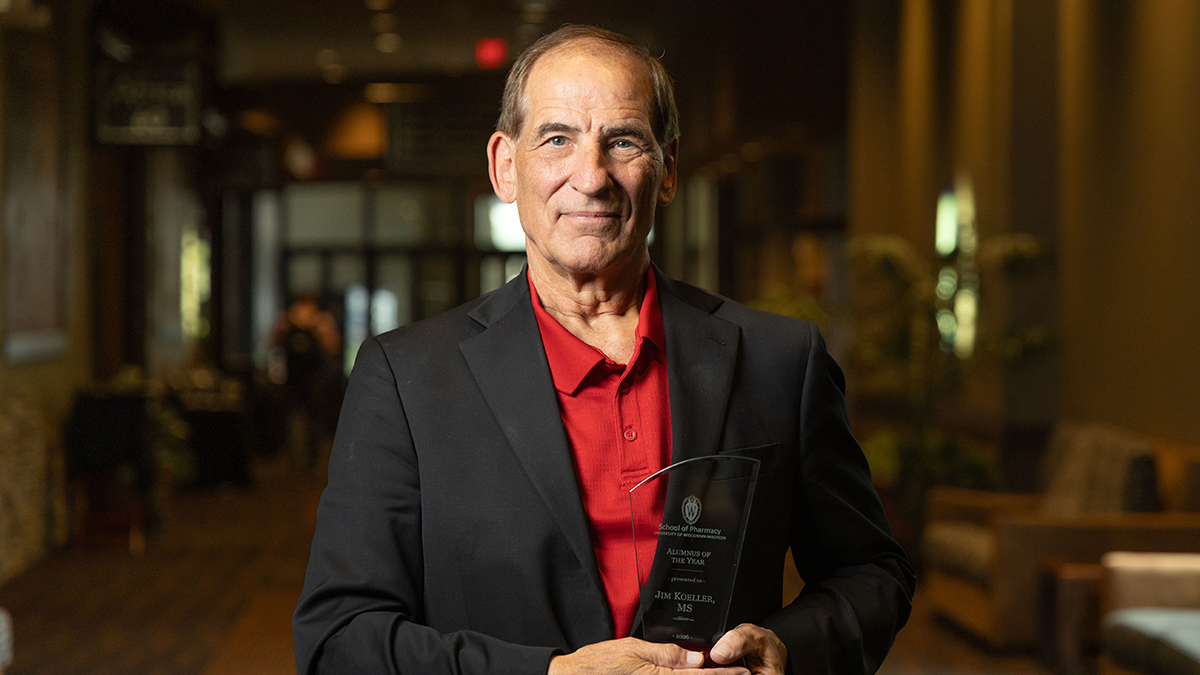
A pillar in oncology pharmacy, Koeller helped transform the landscape of cancer care for over 40 years.

Ladell is recognized by the Pharmacy Alumni Association for pharmacy leadership and ongoing commitment to community.