PharmD students embark on international service-learning trips to Central America
“This is our patient. What are we going to do?”
The question came up at a mobile clinic in Guatemala, where Caroline Brandeberry, third-year PharmD student at the University of Wisconsin–Madison School of Pharmacy, was volunteering alongside medical students to provide care to local patients.
“It’s one thing to be in a classroom and talking through a scenario, and it’s another thing to be in the field,” says Brandeberry. “Having that experience is invaluable.”
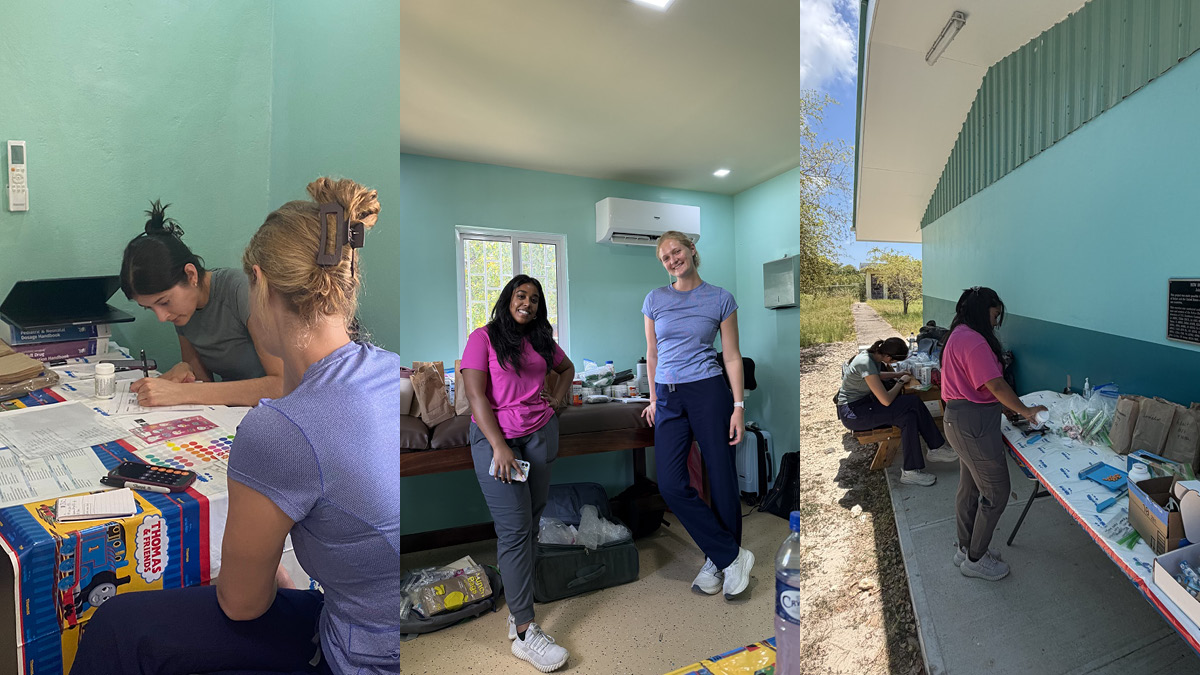
This summer, Brandeberry was in one of three groups of student pharmacists traveled to communities in Guatemala and Belize for service-learning trips, providing patient care alongside students and professionals from other health disciplines.
“I’ve always been interested in international travel, and I thought it’d be interesting to see pharmacy and healthcare from a different perspective in a different country,” says third-year PharmD student Jasmine Kuhnhenn, who participated in this year’s Belize trip, alongside fellow third-year PharmD students Katherine Kitslaar and Sadiyya Rahaman.
“It’s one thing to be in a classroom and talking through a scenario, and it’s another thing to be in the field. Having that experience is invaluable.”
–Caroline Brandeberry
Organized with the UW School of Medicine and Public Health, these trips offer the chance to practice pharmacy in healthcare systems outside of the US, collaborate across specialties, and adapt care to unique patient and community needs. PharmD students participate in these trips after completing their second year in the program and their pharmacology and pharmacotherapy training.
“What I see from these students is real enthusiasm for patient care,” says Associate Professor Karen Kopacek, the faculty advisor for these international trips. “They begin blossoming as they take what they’ve learned in the classroom and the skills they’ve developed in the lab and apply them to actual patients.”
Classroom to clinic
In Guatemala, pharmacy students are partnered with medical students on a two-week experience organized and supported by the San Lucas Mission and non-governmental organization, Friends of San Lucas. The pharmacy team was responsible for leading the mobile pharmacy station each day, traveling to eight to 10 communities to provide acute care alongside local health promoters.
In Belize, student pharmacists worked alongside physician assistant (PAs) and nurse practitioner (NP) students through the Belize Family Life Association (BFLA), which sends nurses into various local communities to do cervical cancer screenings. These patient screenings serve as an opportunity for the traveling medical team to offer other routine care checks, including blood pressure and blood sugar.
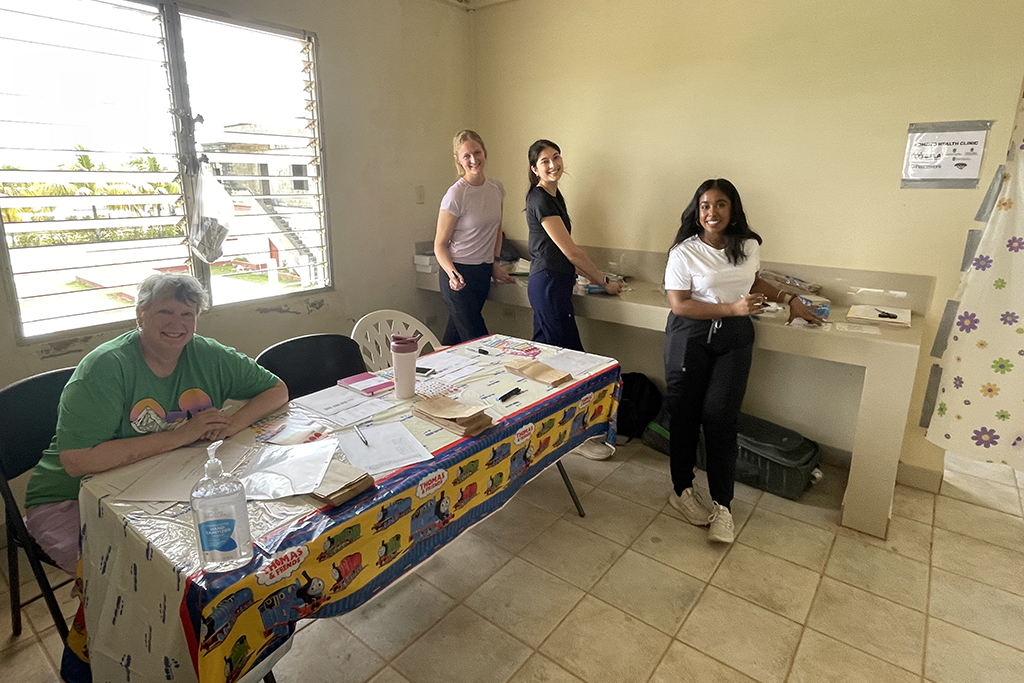
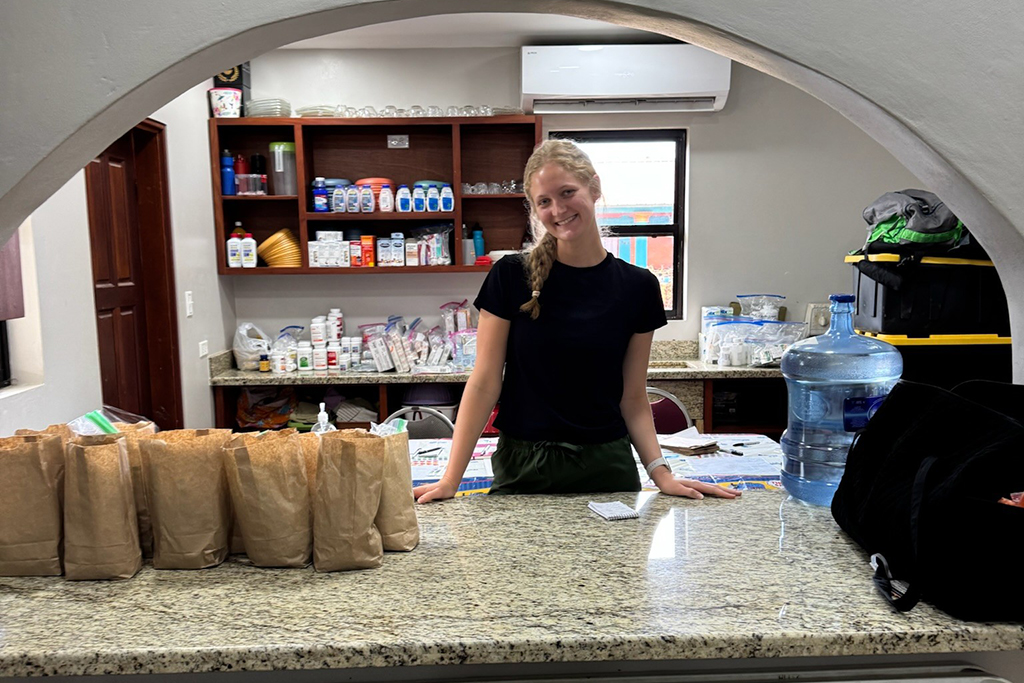
In each mobile clinic, the medical, PA, and NP students would evaluate patients and confirm diagnoses with the faculty providers before presenting their cases to the pharmacy team, who answered medication-related questions and determined treatment plans.
“We discussed why they wanted to prescribe certain medications, made sure everything aligned, gave our recommendations, and eventually came to a consensus,” says third-year PharmD student Hannah Pitterle, who joined Jessica Pollesch, also a third-year PharmD student, and Brandeberry on one of the two Guatemala trips.
“Getting to practice interprofessionally with other healthcare disciplines in a real-world setting was something we haven’t really gotten to experience yet,” says Pollesch.
Working alongside other health professions gave students a better understanding of how each member of the care team contributes to the patient experience. PharmD students had the opportunity to show their peers what pharmacists can contribute, while gaining perspective and insight from the other students and providers around them.
“Working interprofessionally showed how I can have more of a patient-facing impact,” says Kuhnhenn. “Many people don’t understand that pharmacy is so much more than dispensing. Seeing that in real time made me feel more motivated to potentially become a clinical pharmacist and be able to directly see and help patients.”
Cross-cultural connection
Students not only adjusted to new colleagues; they also adapted to a new environment, culture, and health system. It was a familiar process, but in an unfamiliar setting.
When communication was limited due to a language barrier, students utilized translators, widely understood symbols, and even simply connected through shared body language.
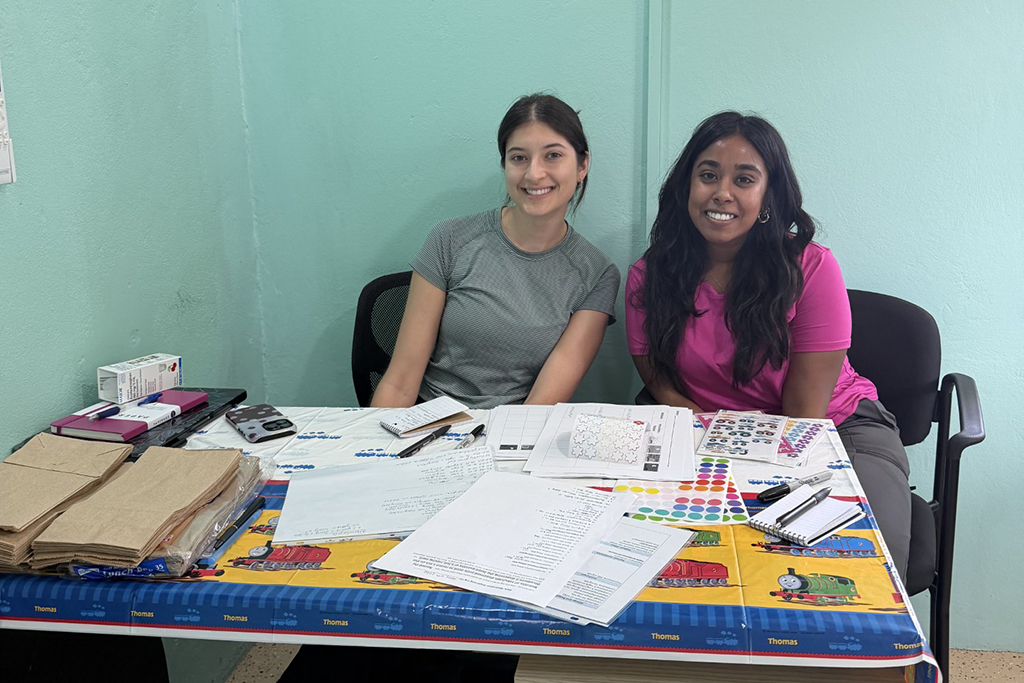
At the clinics, students wrote prescription instructions in Spanish or English for each patient and labeled their medications with stickers that corresponded to drugs listed on their medication sheet. These sheets and stickers help patients remember which medication to take and when, using drawings of celestial bodies and solar positions in the sky to indicate the appropriate time of day. Adapting a method recommended by the World Health Organization to improve medication adherence, students would indicate morning dosages with the sun rising in the sky, and nightly dosages with the moon.
“This way, the patients knew how to safely take their medication, and we could get past language barriers,” says Pitterle.
Beyond just medical conversations, students took the opportunity to immerse themselves in Central American culture, transcending language to connect with their patients.
“Even though there was a language barrier, the local children were so willing to talk and show us warmth by sharing their things with us, holding our hands, or hugging us,” says third-year PharmD student Julia Choi, who traveled to Guatemala alongside Janae Lefleur and Jenna Wuest, also third-year PharmD students. “It was a beautiful moment where you realize how important our body language is, even though we don’t speak the same language.”
“It’s important to be curious so we can learn how to adapt and grow in a new environment, whether it’s a different health system, different country, or just a different practice area.”
–Katherine Kitslaar
Working within a different health care system also means navigating diverse patient needs and limited resources. For Kuhnhenn, the experience reinforced the importance of adapting care to each patient.
“Every patient is going to be different, with a different background and a different level of understanding,” she says. “You need to tailor your care to your patient.”
Bringing the experience home
The work of these service trips doesn’t end when the students return home. The experience is part of larger partnerships that are intentionally designed to provide consistent health care to these communities throughout the year.
“These trips are not like other mission trips where providers from the US come to a community and provide care with no plans for follow-up after they leave. Both SMPH experiences are partnered with local health organizations in each country (BFLA and San Lucas Mission) so that continuity of care is available,” says Kopacek, who has participated in these trips for nearly a decade. “I value the friendships we have developed with local providers and health promoters and look forward to working with them again each summer.”
Continuing with these international service trips shapes how students view their own communities, care, and future practice.
“Any healthcare professional should go on this kind of a trip,” says Pollesch, who was moved by seeing the struggles of patients in impoverished and remote communities. “This is a very eye-opening experience of how the rest of the world works. It’s important not to take things for granted.”
For some students, that humbling perspective translates into seeking further international opportunities through the School, such as fourth-year clinical rotations in countries like Thailand, Spain, South Africa, and more, or pursuing a Global Health Certificate.
For others, it leads to continued service at home. According to Kopacek, many medical, PA, and pharmacy students who have participated in the Belize and Guatemala trips also volunteer with MEDiC, a UW–Madison student-run organization clinic that supports four free clinics.
“Many students want to use their heightened awareness, understanding, and humility from these summer experiences to provide care locally to the underserved in Madison,” says Kopacek, who also volunteers at MEDiC. “MEDiC provides an opportunity for trip participants to continue helping others in need at home — not just internationally. As a faculty member, it is rewarding to see these students use their newly developed knowledge, skills, and empathy with patients in our own community.”
For Kitslaar, the experience is also a reminder that adapting to change will be part of her future as a pharmacist.
“It’s important to be curious so we can learn how to adapt and grow in a new environment, whether it’s a different health system, different country, or just a different practice area,” she says. “Going forward, pharmacy will change and the world will change, and we need to be able to change with it.”

Through a series of short videos, current students take you inside the labs, clinics, and experiences shaping the next generation of pharmacists.
U.S. News & World Report ranks UW–Madison #6 Best Pharmacy School in 2026.