The School of Pharmacy’s Analytical Instrumentation Center supports critical research across UW–Madison and beyond
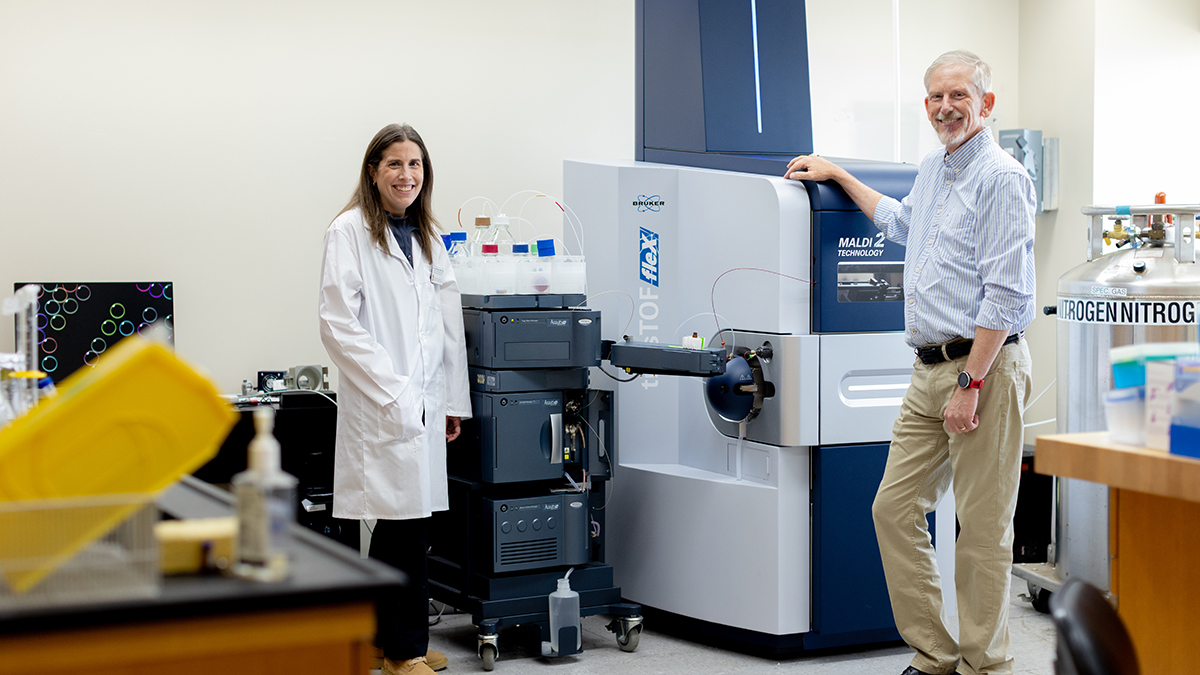
Without facilities like the Analytical Instrumentation Center, critical research wouldn’t be possible. The core facility in the University of Wisconsin–Madison School of Pharmacy is home to complex state-of-the-art scientific equipment — and to the experts who know how to use it.
Just ask Owen Tamplin, an associate professor of cell and regenerative biology at UW–Madison. Tamplin’s recent research into blood stem cells hit a breakthrough when he found that “GABA produced by multiple bone marrow cell types regulates hematopoietic stem and progenitor cells.” The mechanism he and his research team discovered may eventually be used to improve recovery of the blood system after transplantation, among other possibilities.
The finding earned Tamplin and his team a cover story from Stem Cell Reports. To get there, the researchers used the specialized equipment at the AIC’s Mass Spectrometry Facility. That is just one example of the scores of researchers who pass through the AIC every year, taking advantage of the high-tech instruments to further scientific progress.
“We’re meeting researchers’ needs […] Many institutions don’t have this kind of facility.”
–Cameron Scarlett
“We’re meeting researchers’ needs,” says Cameron Scarlett, the AIC’s director of mass spectrometry. “And that’s not just at the School of Pharmacy and UW–Madison. We analyze samples from Marquette University, from other UW branches, from commercial entities — even from as far away as Toledo. Many institutions don’t have this kind of facility.”
Building a state-of-the-art facility
In the early ’90s, the School of Pharmacy was outgrowing itself. Chamberlin Hall, built in 1905, had housed the School for decades. But as the School grew, it needed more space. And so, in 1992, School leaders launched a $45 million project to create a new home for pharmacy at UW–Madison: Rennebohm Hall.
“This is finally going to give the faculty and staff of our school a facility that will match the excellence of their abilities,” said Melvin Weinswig, then dean of the School of Pharmacy. “We’re tremendously excited.”
In the midst of that massive change, the School set out to make its new home state-of-the-art for researchers, and that meant bringing in some major instrumentation. The School began securing mass spectrometry and nuclear magnetic resonance (NMR) spectroscopy equipment, which led to the official launch of the AIC, split into two divisions: NMR, which is run by Sheng Cai, and mass spectrometry, which brought Scarlett to Madison in 2006 to serve as director.
In the 20 years since, the facility has only grown, introducing increasingly sophisticated equipment capable of tackling challenging projects. Now part of the Lachman Institute for Pharmaceutical Development, which launched in 2022, the AIC is supported by the estate of Leon Lachman (PhD ’56), who funded the institute to further the School’s research capabilities.
Valued expertise
Anyone lacking a particular scientific background might be wondering what exactly a mass spectrometer does. The answer, as you might imagine, is complex. To put it at its most simple, it analyzes chemical substances.
The mass spectrometer converts molecules into a gas-phase ion, which gives it an electrical charge, allowing the machine to determine molecular weight, identify unknown substances, and more. A researcher, for example, might want to see exactly how much of a certain amino acid is found in a cell — a measurement that’s not possible without specialized equipment.
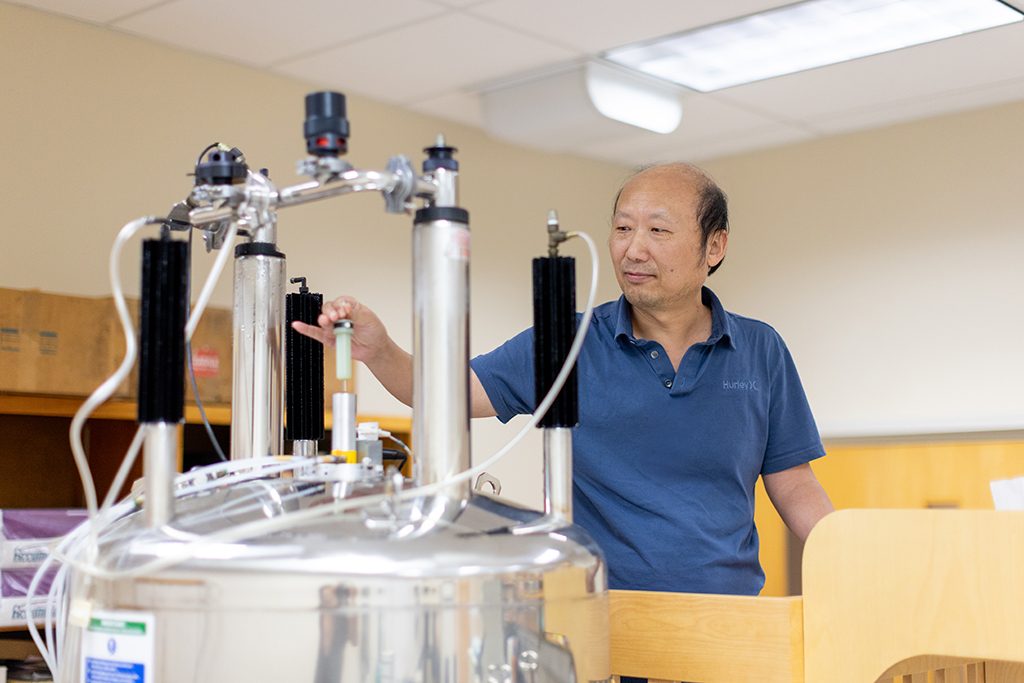
The NMR equipment instead examines the molecular structures themselves and their interactions, which can be used to study the interaction between drug molecules and target proteins.
“It acts like a fingerprint for a compound,” says Cai. “Each molecule has its unique NMR spectrum. When a user designs a drug molecule and synthesizes it, a quick NMR spectrum alone is enough to tell if the compound is what is expected or how pure it is.”
This means that some researchers need to use the NMR spectrometers daily.
Needless to say, that equipment is quite expensive and requires expertise to use, meaning access to it is at a premium for scientists.
“This is high-tech chemical analysis instrumentation,” says Scarlett, who received his PhD from University of Michigan. “A regular principal investigator will probably not have this in their lab. There are other mass spectrometers on campus, but what makes the AIC’s unique is that students can actually use it.”
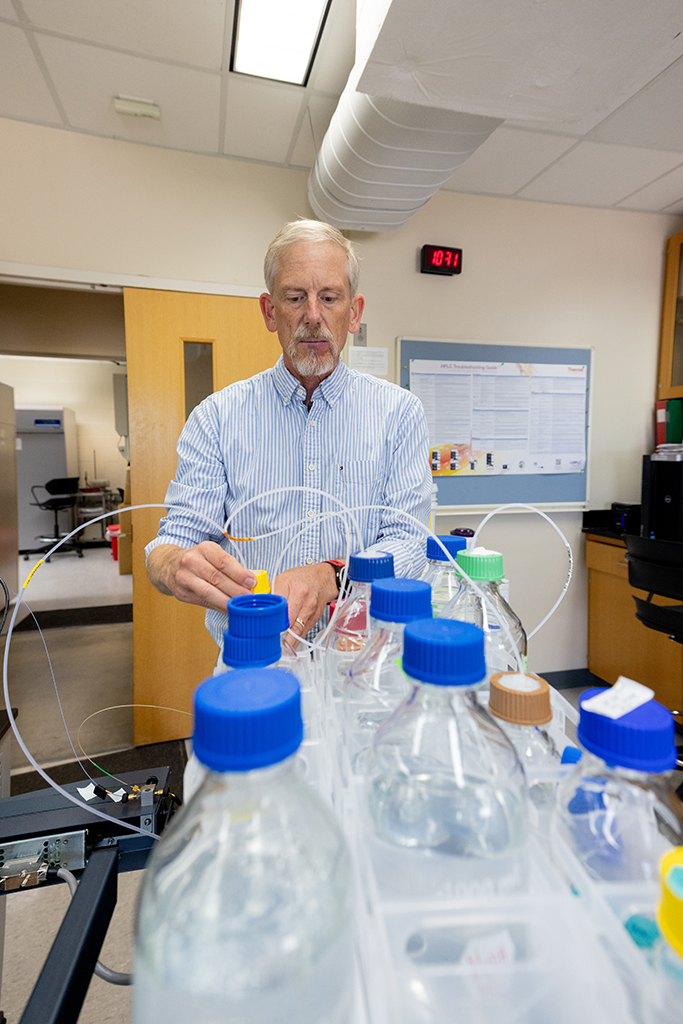
PhD students, with training and oversight from the mass spectrometry team, have access to the core facilities’ tools to further their research, the same as top scientists and researchers. The nuances of mass spectrometry can mean that training for a project might take up to two months. The substances being measured are in direct contact with the machine, which means the danger of an improperly used sample “gumming up” the spectrometer is serious.
“Researchers wouldn’t be able to finance this kind of instrumentation themselves,” says Molly Pellitteri Hahn, a researcher in the Mass Spectrometry Facility who also holds a master’s in science. “If core labs like this didn’t exist, then they wouldn’t have access to these tools. And beyond the equipment itself, there’s the expertise of the scientists in these facilities who know how to properly use them.”
A research accelerator
When Owen Tamplin’s research team first approached the AIC Mass Spectrometry Facility, it was because they had reached an impasse. In their research into blood stem cells, they were pretty sure that the amino acid GABA was playing a critical role in hematopoiesis, the process of making new blood cells and platelets in the body — but they couldn’t figure out exactly how much GABA was in the cells they were studying.
That was where Scarlett and Pellitteri Hahn stepped in. They used the mass spectrometer equipment to measure GABA in the cell culture supernatant. That was easy enough, Scarlett says, but then Tamplin presented a fresh challenge — analyzing GABA in bones and bone marrow.
“We had to figure out how to homogenize the bones first, and then extract GABA from the bones,” Scarlett says. “It was tricky.”
The expertise Pellitteri Hahn talks about came into play, as they determined how exactly to accomplish what the researchers were asking of them. They landed on a complex solution that involved extracting the GABA from bones and comparing it with GABA diluted in water. And while Tamplin’s team earned that Stem Cell Reports cover, they’re far from done with their research.
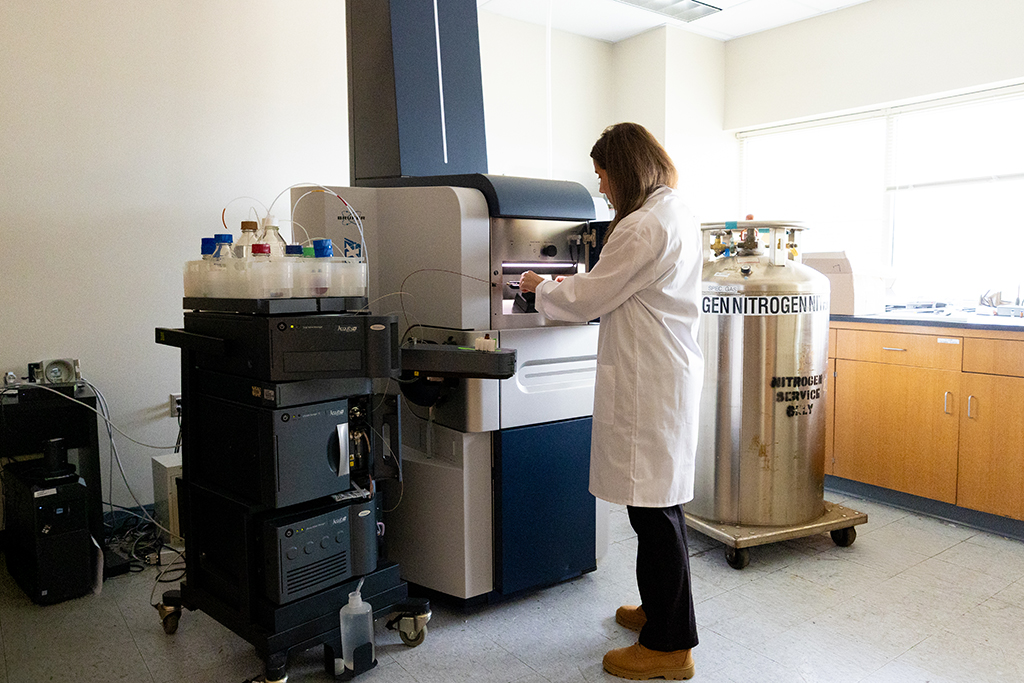
“We started with something simple, and then more difficult, and now their research just keeps evolving,” Scarlett says. “They’re figuring out more interesting questions that they want answered.”
Another key asset in the center is Professor of Pharmaceutical Sciences Lingjun Li, the faculty advisor for the AIC’s MS Facility and an internationally recognized leader in mass spectrometry-based neuroscience.
Cody Wenthur, associate professor of pharmacy at the School, is another frequent user of the AIC. Wenthur’s research revolves around psychoactive substances, and his team works with the AIC to measure psilocybin, LSD, and other substances to better understand how they work — and their therapeutic potential.
Assistant Professor of Pharmacy Sean Lim’s research group is attempting to determine the pharmacokinetics of certain compounds to improve drug delivery, a complex effort that requires use of the mass spectrometer. Scarlett and Pellitteri Hahn have also trained graduate students from Professor of Pharmaceutical Science Tim Bugni’s research team, helping them discover data that has led to the development of new antibiotics. Bugni’s research group also regularly works with the NMR equipment, as does Professor Weiping Tang’s lab, which uses the instruments to confirm the structures of newly synthesized compounds and monitor their chemical reactions.
“It’s fun,” Pellitteri Hahn says of her work. “As it evolves, you get the chance to try new things. We’re presented with problems, and we have to collaborate and try to work it out.”
Quanyin Hu, an associate professor of pharmaceutical sciences, uses the facility to better understand protein degradation, determining how particular proteins react to different treatments. His research has led to the development of a new class of protein degrader that targets disease-related proteins, which could improve immunotherapy treatments for cancers.
“As it evolves, you get the chance to try new things. We’re presented with problems, and we have to collaborate and try to work it out.”
–Molly Pellitteri Hahn
The AIC also frequently supports the Zeeh Pharmaceutical Experiment Station, which works with dozens of on- and off-campus partners on drug development projects.
And all of this work is being noticed. This year, Li and the AIC received a Research Core Revitalization grant from UW–Madison to upgrade an ultra-high pressure liquid chromatography/triple quadrupole mass spectrometer, as well as a $1.03 million grant from the National Institutes of Health to fund the purchase of a SCIEX ZenoTOF 8600 system to push the center’s mass spectrometry capabilities even further. The new ZenoTOF system will serve 23 users with 66 federal contracts or grants across campus.
“By working with many people and supporting their needs, we’re able to fund and afford this more complex instrumentation that can, in turn, accomplish more,” Scarlett says.

School of Pharmacy Associate Professor Jennifer Golden and her collaborators are developing potential drugs for a severe brain infection caused by water contaminated with N. fowleri.