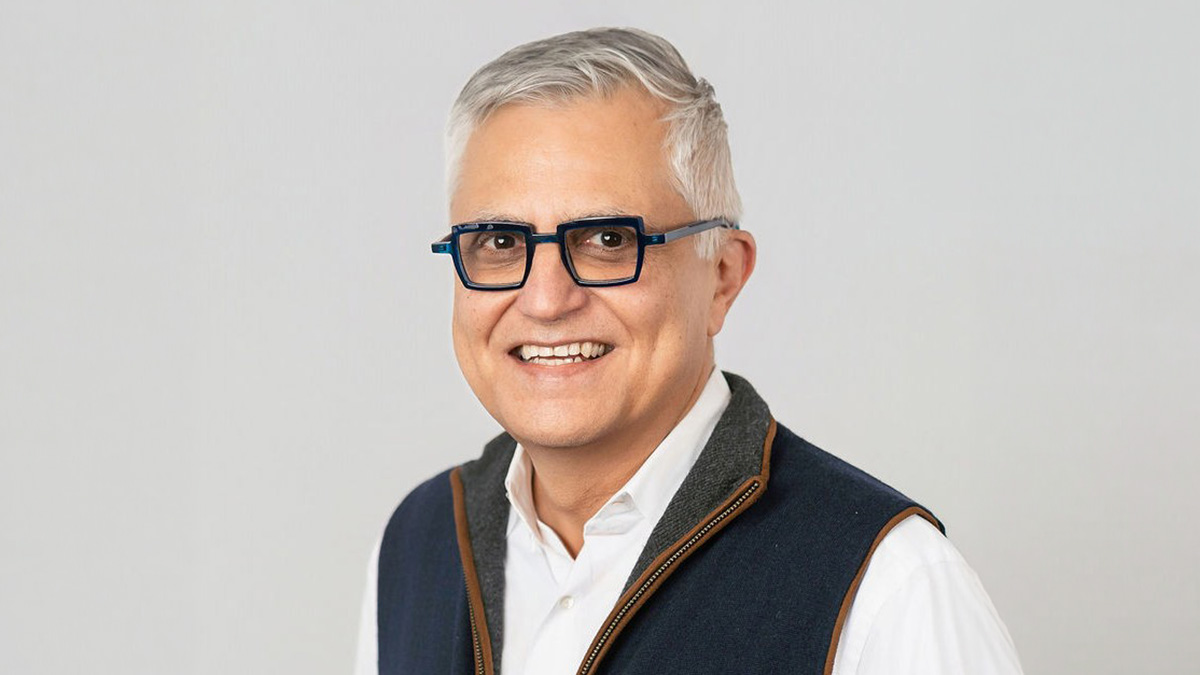
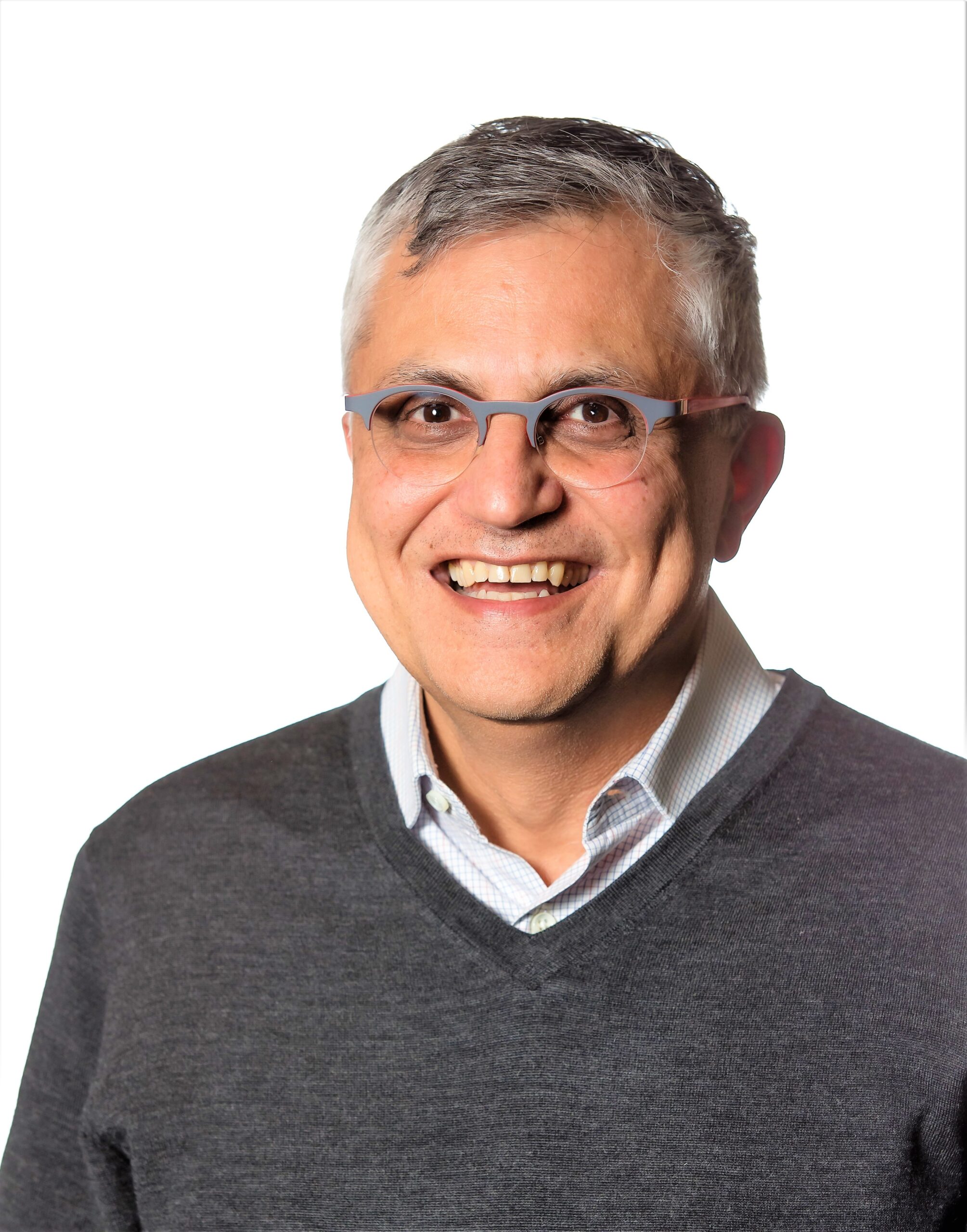
School of Pharmacy alum and Teva R&D executive Mehran Yazdanian shares what it takes to bring a biosimilar to market and what changes in the field mean for patients and pharmacists
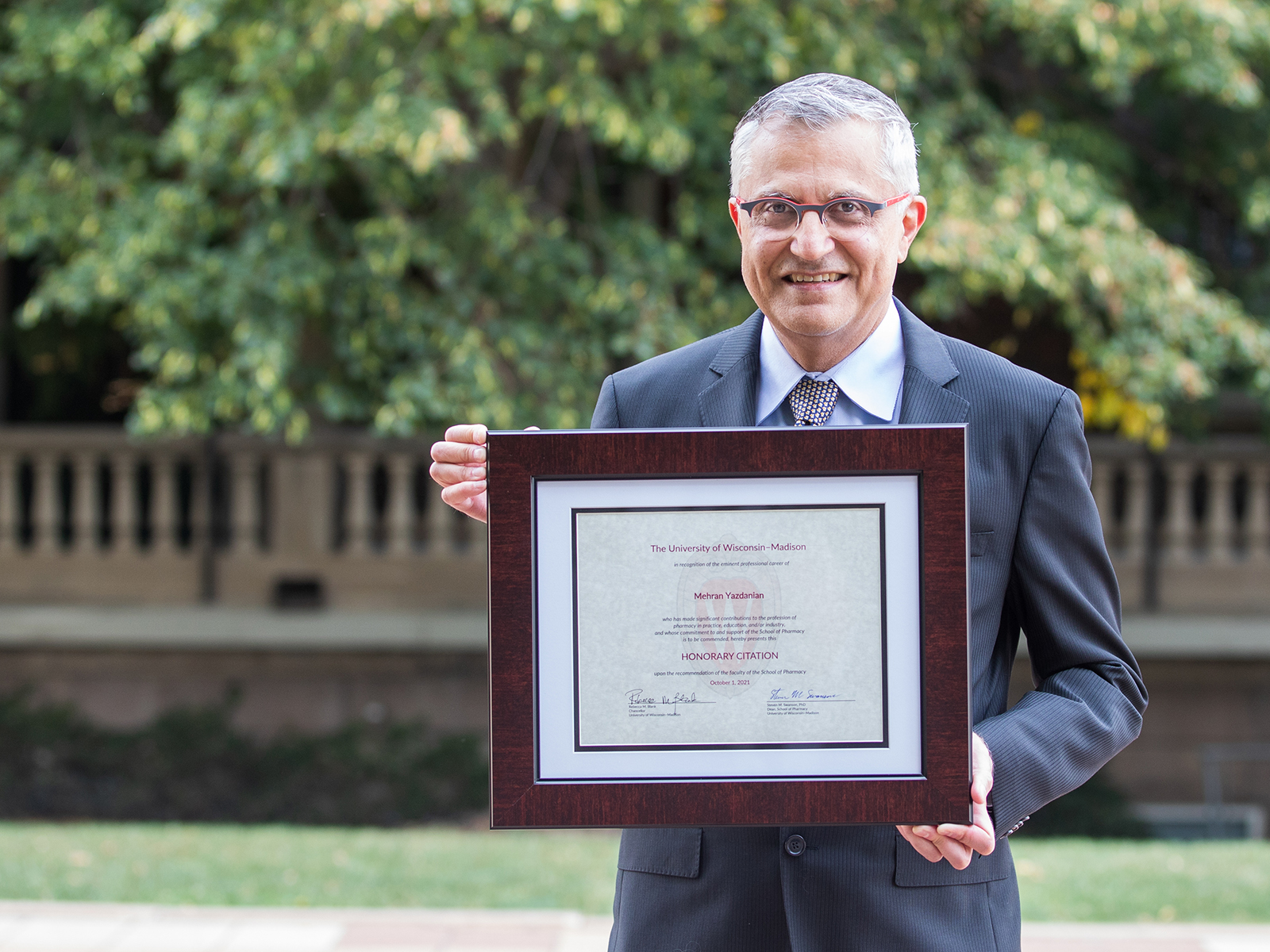
In the late 1980s, when Mehran Yazdanian (MS ’88, PhD ’90) was a graduate student at the University of Wisconsin–Madison School of Pharmacy, a new, seemingly implausible pharmaceutical technology was starting to rise — one that would later become Yazdanian’s career.
“What’s remarkable is that when I was in graduate school at Wisconsin, we didn’t think we would be able to deliver proteins as we could small molecules. We thought that small molecules would be the mainstay — that proteins were just an aberration, that we could deliver insulin and a couple of other things, and that it wasn’t going to be a big market,” he says. “Three decades on, biologics are the mainstay of our industry. People are helping patients across diseases we didn’t think we’d ever be able to treat. That is amazing.”
Rather than synthesized small-molecule chemicals — like acetaminophen — biologics are large, complex molecules derived from living organisms. They’re made by growing modified cells in a lab, which then produce the therapeutic protein or genetic material, including monoclonal antibodies and hormones.
“People are helping patients across diseases we didn’t think we’d ever be able to treat. That is amazing.”
–Mehran Yazdanian
While small-molecule drugs have generic versions that are chemically identical, biologics instead have biosimilars — distinct yet highly similar medications that are grown from different cells and demonstrate no clinically meaningful differences in safety or efficacy.
Yazdanian has spent 35 years in pharmaceutical development, from small molecule formulation at Merck, to chemical characterization and permeability studies at Boehringer Ingelheim, expanding into biologics first at Cephalon, and now at Teva Pharmaceuticals, where he is vice president of research and development operations.
He leads Program Leaders for biosimilar development from clone selection to regulatory submission, and he has a front-row seat to the evolution of biosimilars. Yazdanian, who also serves on the School’s Board of Visitors and on the advisory board of the Zeeh Pharmaceutical Experiment Station, shares his perspective on the changes reshaping the field and what they mean for patients and pharmacists.
What makes biosimilar development fundamentally more demanding than generic drug development?
The reasons are rooted in science. Generics are very straightforward: You’re making small molecules that are easy to synthesize. You know what the molecular structure is, you can synthesize it, you can make it exactly the same every time — like making aspirin.
Biologics are large, complex, heterogeneous molecules. They come from cells — each company uses different cell clones to produce the same protein. My product is similar to yours, but it’s not exactly the same. It has the same effect, the same properties, but we make it differently, and it might never be exactly the same. That’s why the term is “biosimilar” rather than “biogeneric.” The process is the product for biologics. Even subtle changes in manufacturing can alter the molecule.
Biosimilar developers must rigorously demonstrate high similarity to the reference product. This level of scientific scrutiny drives development costs to over $100 million, with longer timelines — at least seven to nine years from making a clone to having a finished biosimilar product. Add immunogenicity risks, inherent reference product variability, and a regulatory framework built on the totality of evidence, and it becomes clear that biosimilar development is far more complex than even innovator biologics. It’s a big challenge. But the industry is doing it, and the FDA has given us the blueprint of what they expect.
Of 118 biologics losing patent exclusivity in the next decade, only 12 have biosimilars currently in development. Is that thin pipeline an opportunity, or does it speak to challenges?
It all depends on the number of patients and how much money there is to recoup the investment. Since biosimilar development costs over $100 million per drug, if your market is only a couple of million dollars a year, a company is not going to invest that money — just because the return on investment isn’t there. This is a high bar for biologics with orphan or niche indications. Not because you don’t want to help the patient, but because you don’t have the capital to spend on something that may be marginally less expensive than the brand and that you may never recuperate your costs.
The reduction in cost for biosimilar development, compared to an innovator biologic, comes from the fact that you know exactly what you’re supposed to make — so the duration is less. When you develop an innovator molecule, you have so many uncertainties; you’re spending a great deal of money to ensure that whatever you have is safe, effective, and has the efficacy you want. That helps with cost reduction for biosimilars, but it’s still a very high bar.
An April 2025 executive order explicitly targets biosimilar approval acceleration, and the FDA has active draft guidance on biosimilar development open for public comment right now. What are the most consequential changes?
New FDA and global guidelines are streamlining development, but organizations must adapt quickly to take advantage of them. Drug development takes years — you plan things far in advance. Everything changes, and you can’t always just pluck a product out of the process.
The FDA draft guidance proposes to eliminate comparative efficacy studies as a default requirement, accepting pharmacokinetic similarity and immunogenicity assessment as sufficient — in addition to analytical biosimilarity assessment. It also considers many approved biosimilars as interchangeable, eliminating the costly switching studies that were previously needed to obtain interchangeability designation. And it allows the use of non-U.S. reference products, reducing the cost of acquiring reference-labeled products.
What do you think the U.S. biologics market will look like 10 years from now?
I assume more patients will have access to biosimilar products. And looking out further, gene delivery is a very big field. There are also protein degraders that people are using to go after different targets. A lot of what will happen is driven by changes in how we compute things — the data we currently have, and the use of AI.
One of the great benefits of AI is that it allows us to look at things we already have and predict things in the future much more easily, showing us what we can do for the development of drugs for future treatment of patients. It sounds like a cliché that everyone is jumping on AI, but it’s a very good tool.
As biologics and biosimilars reshape the drug development landscape, what do aspiring pharmaceutical scientists need to know and do today to be ready for where the field is heading?
The pharmaceutical development field has changed fundamentally from the one I joined 35 years ago. Biologics now account for the majority of new drug approvals, and the biosimilars market is growing rapidly. Here is what I would tell any young scientist looking to build a career in this space:
Develop knowledge in both small and large molecules. This is essential for flexibility in your career development and employment options. Knowledge of fundamentals — physical chemistry, formulation development, and drug delivery — is essential for both. In addition, protein chemistry, cell biology, and immunology are a must for biologic development.
“Always stay curious and engaged so that you can expand your scientific knowledge and add value to your organization.”
–Mehran Yazdanian
Remember that in biologics development, the process is the product. A subtle change in manufacturing can alter a biologic’s clinical profile. Scientists with expertise in cell line development, process characterization, and state-of-the-art analytical technologies will be in high demand.
Understand the regulatory landscape. Global regulatory strategy is now a core competency, not a specialty. The FDA and European Medicines Agency are streamlining biosimilar pathways — eliminating default comparative efficacy studies and easing interchangeability requirements — and you need to be able to adapt to those changes as they come.
Finally, always stay curious and engaged so that you can expand your scientific knowledge and add value to your organization.