The professorship supports Professor Jiaoyang Jiang’s work to investigate disease-driving protein modifications linked to cancer, neurodegenerative disorders, and more
By Susan Smith
When a Latvian family arrived in Madison as church-sponsored refugees after World War II, they began a journey that would ultimately shape the future of pharmacy education and research.
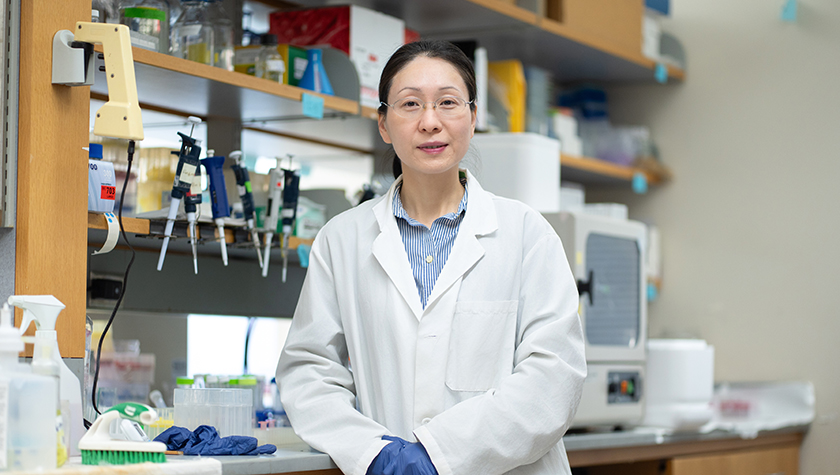
Their latest contribution is the establishment of the University of Wisconsin–Madison School of Pharmacy’s Anna Apinis Professorship in Pharmaceutical Sciences in 2020. This year, it’s being awarded for the first time to support the research of Jiaoyang Jiang, professor of pharmaceutical sciences, who has made her own journey halfway around the world in pursuit of scientific discovery.
“I am honored and deeply grateful to be the inaugural recipient of the Anna Apinis Professorship,” says Jiang, who was also recently honored with a Vilas Faculty Mid-Career Investigator Award. “This support will help advance our research in meaningful ways, and I am delighted to be connected with the Apinis family.”
“I am honored and deeply grateful to be the inaugural recipient of the Anna Apinis Professorship. This support will help advance our research in meaningful ways, and I am delighted to be connected with the Apinis family.”
–Jiaoyang Jiang
Jiang’s research explores the molecular mechanisms and biological functions of protein post-translational modifications involved in human physiological and pathological processes, ranging from cancer and fibrosis to neurodegenerative diseases.
“Jiaoyang is an outstanding choice for the inaugural Anna Apinis Professorship,” says Steve Swanson, dean of the UW–Madison School of Pharmacy. “Her innovative research has the potential to reveal entirely new drug targets and therapeutic strategies, and her dedication to mentoring trainees strengthens our scientific community. She exemplifies the excellence this professorship was created to support.”
Latvian roots, Wisconsin future
Nearly 100 years ago, both Anna Apinis and her husband, Janis, earned master’s degrees in pharmacy in Latvia before the outbreak of the war. Janis was director of the national drug manufacturing facility, and the couple later bought a pharmacy, where they worked together. But Latvia’s geography meant it was first invaded by the Soviet Union, then the Germans. When the Soviets invaded a second time, the couple decided they and their two small children, John and Rasma, had to leave or risk being sent to Siberia. At the war’s end, the family was living in a refugee camp in the American Sector of West Germany.

Because of their background in pharmacy, the couple received two resettlement offers. They chose the one from Luther Memorial Church in Madison, Wisconsin, which offered them inexpensive housing and a job for Janis at the Madison Drug Company warehouse.
John Apinis remembers arriving in Madison with luggage tags attached to their coats to make sure they got to their destination, as none of them yet spoke English.
The couple soon learned that their Latvian pharmacy degrees were not valid in the United States. Janis enrolled at the UW–Madison School of Pharmacy, graduating in 1954 and taking a job at Madison General Hospital (now Meriter). Meanwhile, Anna supported the family by working as a janitor.
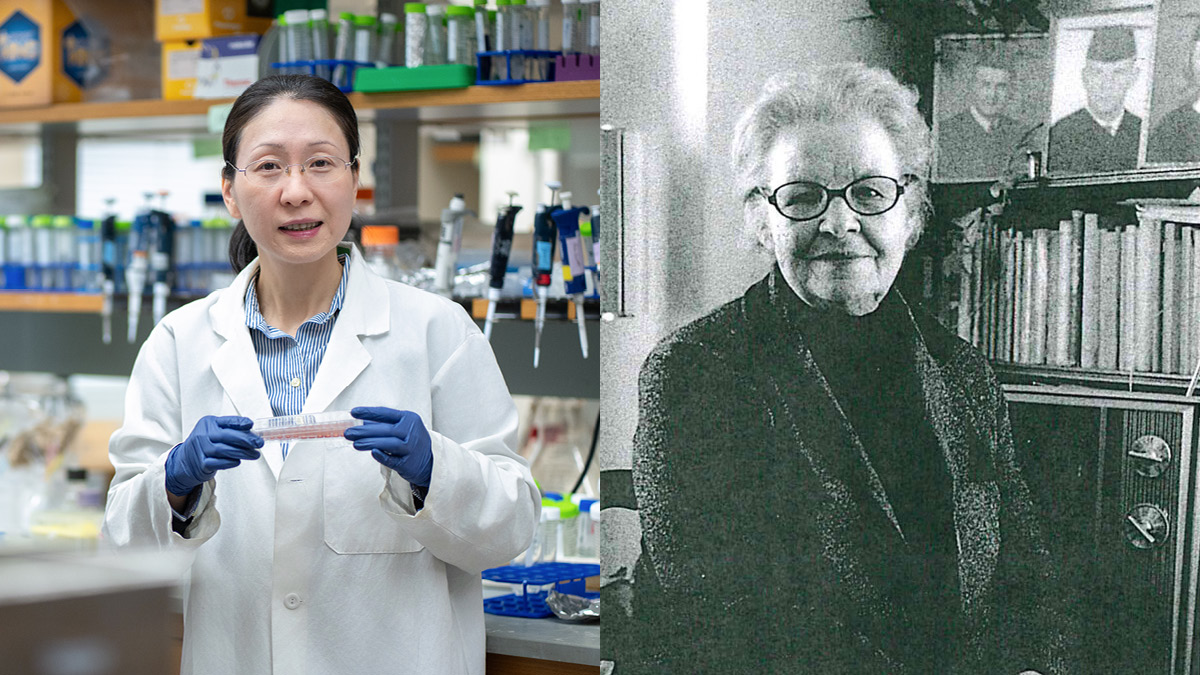
Eventually, Anna was able to return to the health sciences, working in the lab of Frederic Mohs, a researcher and cancer surgeon at the University of Wisconsin Hospital. Mohs is known for developing an internationally used surgical method of removing thin layers of skin cancer, examining it under the microscope in the lab, then removing and examining more layers until the margins around the lesion are free of cancer. Anna traveled around the country teaching Mohs Radiographic Surgery lab techniques.
John Apinis has said he is excited by the potential of UW’s drug discovery research and feels supporting such research is a fitting tribute to his mother’s career.
“My mother Anna started and ended her career in the healthcare profession, so it makes sense to connect her to this professorship.”
–John Apinis
“Of all the different options, this focus struck me as being the closest to the cutting edge of new results, breakthroughs, and new advances, with the greatest potential for something really great,” says John. “My mother Anna started and ended her career in the healthcare profession, so it makes sense to connect her to this professorship.”
The Anna Apinis Professorship joins the earlier Janis Apinis Professorship in Pharmaceutical Sciences, which currently supports the research of Professor of Pharmaceutical Sciences Weiping Tang, as well as three scholarships for PharmD students.
Driving innovation in drug discovery
Like the professorship’s namesake, Jiang’s early education took place far from Wisconsin. She loved learning about science as a child growing up in southeastern China, and she earned her bachelor’s degree in chemistry from the University of Science and Technology of China (USTC), located in Hefei, China. From there, she traveled to the U.S. to earn a PhD in chemistry from Brown University and did postdoctoral studies in chemical biology at Harvard Medical School before joining the UW–Madison School of Pharmacy in 2013.
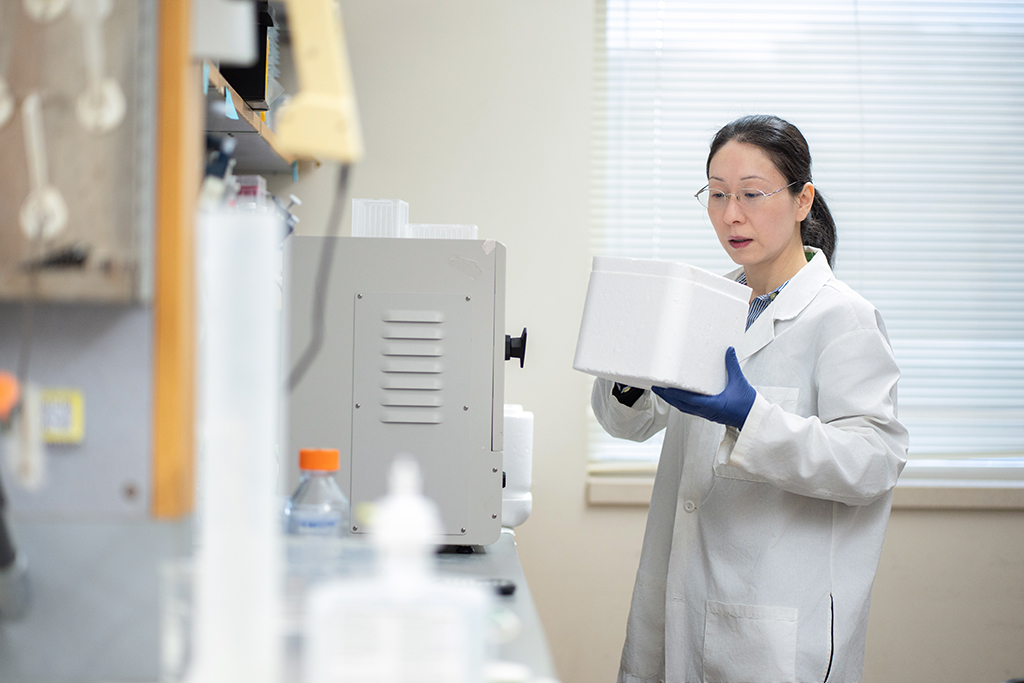
Jiang’s lab is interested in the roles of the enzymes OGT and OGA in adding and subtracting sugar molecules from proteins, a process known as reversible glycosylation.
“It’s a dynamic process, on and off like a cycle,” she says. “That is important because when our body is stressed, for example under nutrient starvation or heat shock, the cell is using this chemical modification to quickly regulate the cellular functions so it can maintain the homeostasis of the body.”
If this essential process gets dysregulated, it can drive the development of a variety of diseases, from cancer and heart disease to autoimmune conditions. A deeper understanding of these enzymes can also open the door to new therapeutics.
“If we can understand disease etiology, how these modifications cause and/or promote the disease, then we can potentially discover new targets for drugs,” she says. “If these enzymes are too highly activated, then we want to block the activity. If the activity is too low, then we may want to boost it. It can lead to some new types of drug targets.”
Jiang’s laboratory is currently supported by two NIH R01 grants, a Wisconsin Partnership Program grant, and a 2025 Vilas Faculty Mid-Career Investigator Award, with work published in high-impact journals such as Nature Chemical Biology, Nature Structural & Molecular Biology, Nature Communications, and PNAS.
Jiang says the support from the professorship comes at a critical time, as federal funding is shrinking while the cost of doing research continues to climb.
“This will help support us to study some novel targets and develop new potential therapeutic strategies,” she says. “It gives us some freedom to explore targets that are at an early stage and not funded by federal support. So in that case, we’ll be able to generate key preliminary data to bolster our future applications for funding.”