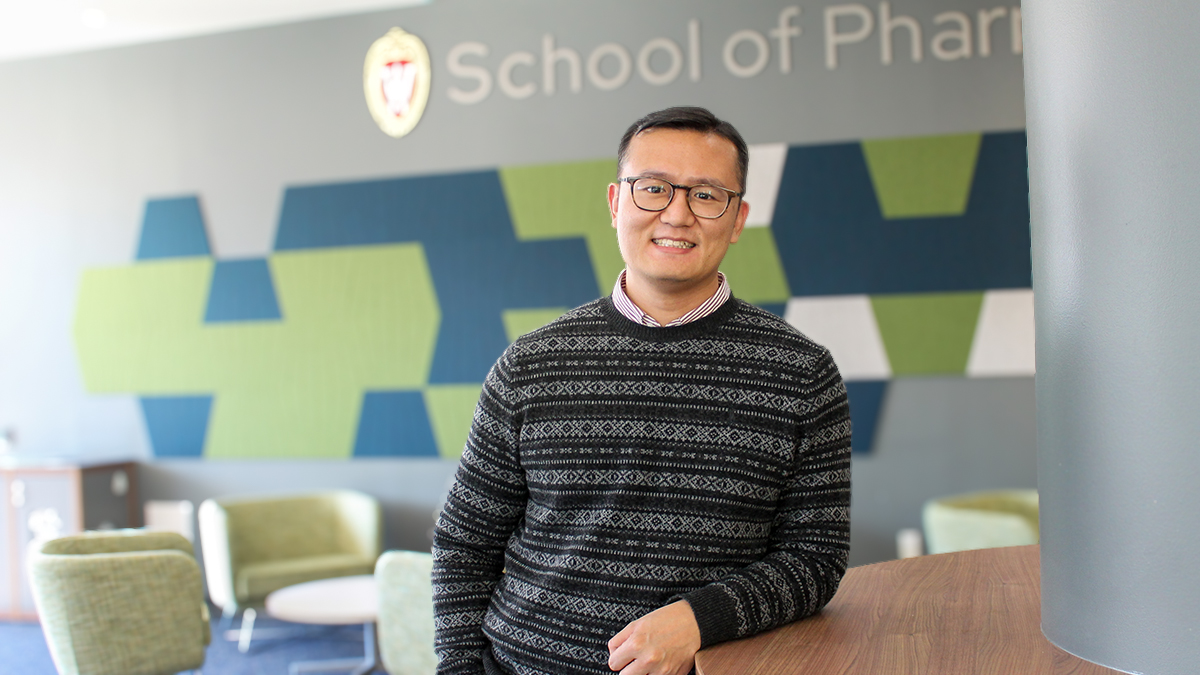
Graduate student Te-Lien Ku draws on his own family and practice experience to study how community pharmacists can support caregivers
Te-Lien Ku has experienced the complexity of managing medications for people with dementia from both sides of the pharmacy counter.
As a pharmacy student in Taiwan, he served as a part-time caregiver to his grandparents: His grandfather was a stroke survivor who had cardiovascular disease and his grandmother had dementia.
“I was supposed to be the person who had knowledge about medications and even I struggled in this process,” says Ku, who is now a graduate student in the University of Wisconsin–Madison School of Pharmacy’s Health Services Research in Pharmacy program. “These experiences really motivated me to do my research.”
Later, he worked for about a decade as a hospital pharmacist, where he would field questions from family members struggling to understand and manage their loved ones’ medications. They would sometimes not recognize individual pills, nor know the medications’ purposes and how they should be taken.
“During my everyday practice, I would get a lot of questions from family members about medications, because most of the time you don’t just have one or two pills; many older adults have multiple conditions with sometimes dozens of pills taken every day, and some of them also have cognitive issues,” Ku says. “It started me thinking that we must find a better system to help these people.”
From experience to action
His experience supporting families through dementia has been the north star of his research, from his master’s in public health research on dementia caregivers to his current doctoral thesis at the School of Pharmacy, as a member of the Ford Research Group, led by Professor of Pharmacy Jay Ford.
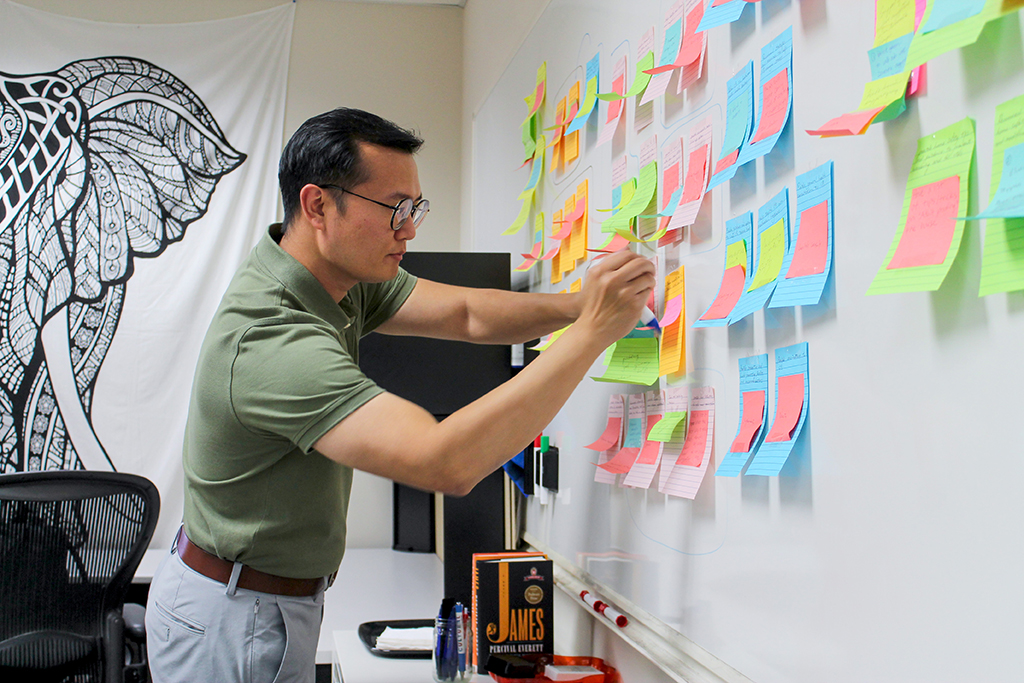
In his earlier research, Ku explored the collaboration between primary caregivers, usually spouses or children, and secondary caregivers, like home health aides, in managing medications for dementia patients. He also conducted a systematic research review of caregiver perspectives on deprescribing medications for older adults with dementia.
Ku also worked with Beth Fields, of the Wisconsin Alzheimer’s Disease Research Center, to modify a caregiver assessment tool — the Care Partner Hospital Assessment Tool (CHAT) — to adapt it for care partners of hospitalized patients with dementia. They used a co-design approach, partnering with clinicians and care partners to create a dementia-specific version (D-CHAT) that reflects additional elements about identifying power of attorney, recognizing care partner responsibilities, and providing dementia-specific educational resources.
Now, Ku and collaborators are testing D-CHAT in a randomized controlled trial at Madison hospitals.
“Being involved in this project has been a valuable experience and has significantly influenced the direction of my dissertation research,” says Ku, who is working to modify another assessment tool, the Family Caregiver Medication Administration Hassle Scale–Traditional Chinese (FCMAHS-TC), to help community pharmacists understand the stresses and challenges family caregivers are facing.
Bringing pharmacies into dementia care
Ku’s next step — and the focus of his thesis — is leveraging community pharmacies as the missing piece in the framework that supports caregivers of people with dementia.
The idea came to him when he was presenting at the 2024 Gerontological Society of America scientific meeting. After his own talk, he attended other talks on innovative strategies to deliver support and interventions to dementia caregivers. He heard many good ideas, but everyone, it seemed, was struggling with how to identify and reach caregivers.
“I was trying to think of a resource in the community where we wouldn’t have to go out and find the caregivers, and then I realized: Yes, it’s community pharmacies,” says Ku. “They’re everywhere, they’re a mature system, they’re basically free and you don’t even need an appointment. You just get in the car, drive five or 10 minutes and talk with the pharmacist.”
“The very clear direction is to integrate pharmacies as important sources in the system of care for people with dementia, and for geriatrics in general.”
—Te-Lien Ku
Ku used a collaborative design process to help design a system in which community pharmacists are embedded in the system of dementia care. To do this, he convened focus groups of community pharmacists and caregivers that met separately and together to discuss shared challenges. When potential solutions were proposed, both groups discussed them to see if they were feasible. The care partners and pharmacists identified a range of support needs and potential services, including dementia-related education, medication management, assistance with navigating caregiving resources and services, and support for care partners’ own health and well-being. They also discussed the feasibility of these services within existing pharmacy workflow and how to make them accessible to caregivers.
Galvanized by these conversations, Ku envisions community pharmacies as a channel that can connect caregivers to broader resources in the community.
“The next step is how we can encourage community pharmacists to strengthen their collaboration with community support resources beyond the healthcare system,” Ku says. “The very clear direction is to integrate pharmacies as important sources in the system of care for people with dementia, and for geriatrics in general.”

I³ award brings Assistant Professor Paula Voorheis and an interdisciplinary team together to improve AI-based disease screening with user-centered design and AI-enabled evaluation.