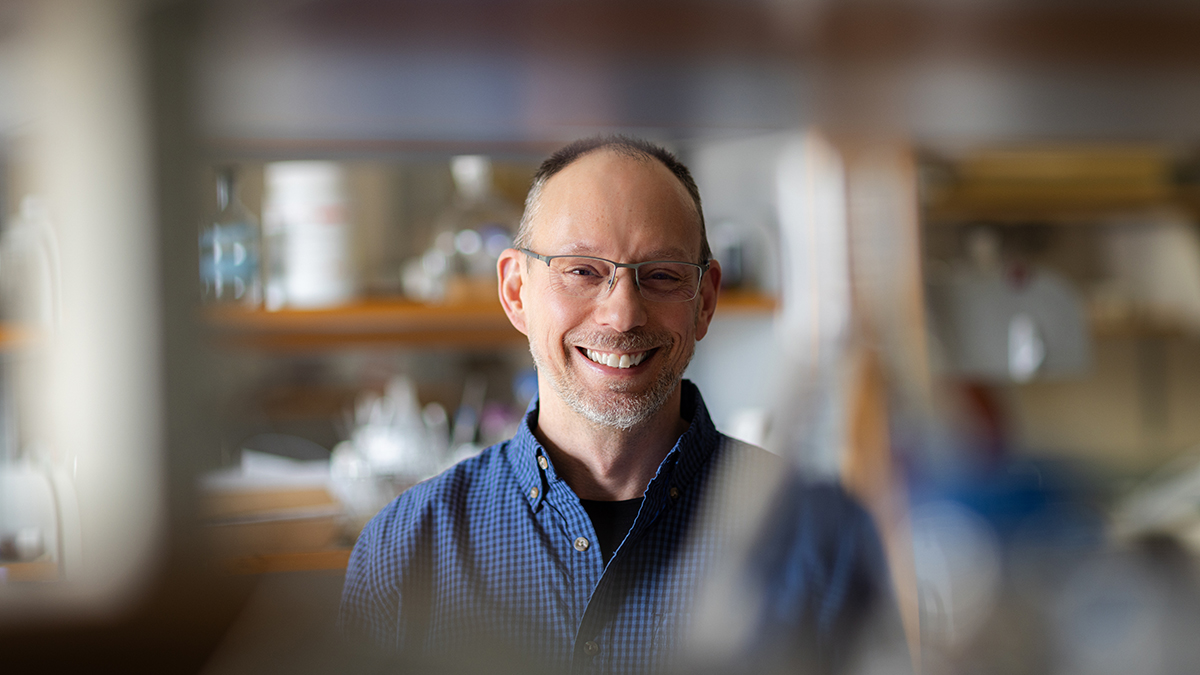
Professors Tim Bugni and Lian Yu are recognized with one of UW–Madison’s top faculty honors for their potent research
Invasive fungal infections strike more than 6 million people each year. With a greater than 50% mortality rate, there’s an urgent need for better treatments.
“We obviously don’t have effective drugs for treating antifungal infections, and it’s getting worse,” says Tim Bugni, professor of pharmaceutical sciences at the University of Wisconsin–Madison School of Pharmacy.
Meanwhile, antibiotic-resistant bacterial infections remain another major threat to human health. To address both needs, the Bugni Research Group is working to develop antifungal and antibiotic compounds derived from marine bacteria. Bugni’s team recently made a breakthrough by discovering a novel class of antibiotic — one of only a handful of novel antibiotics discovered in the past several decades. The novel antibiotic class, which targets methicillin-resistant Staphylococcus aureus (MRSA) with no toxicity toward human cells, is already in early-stage development.
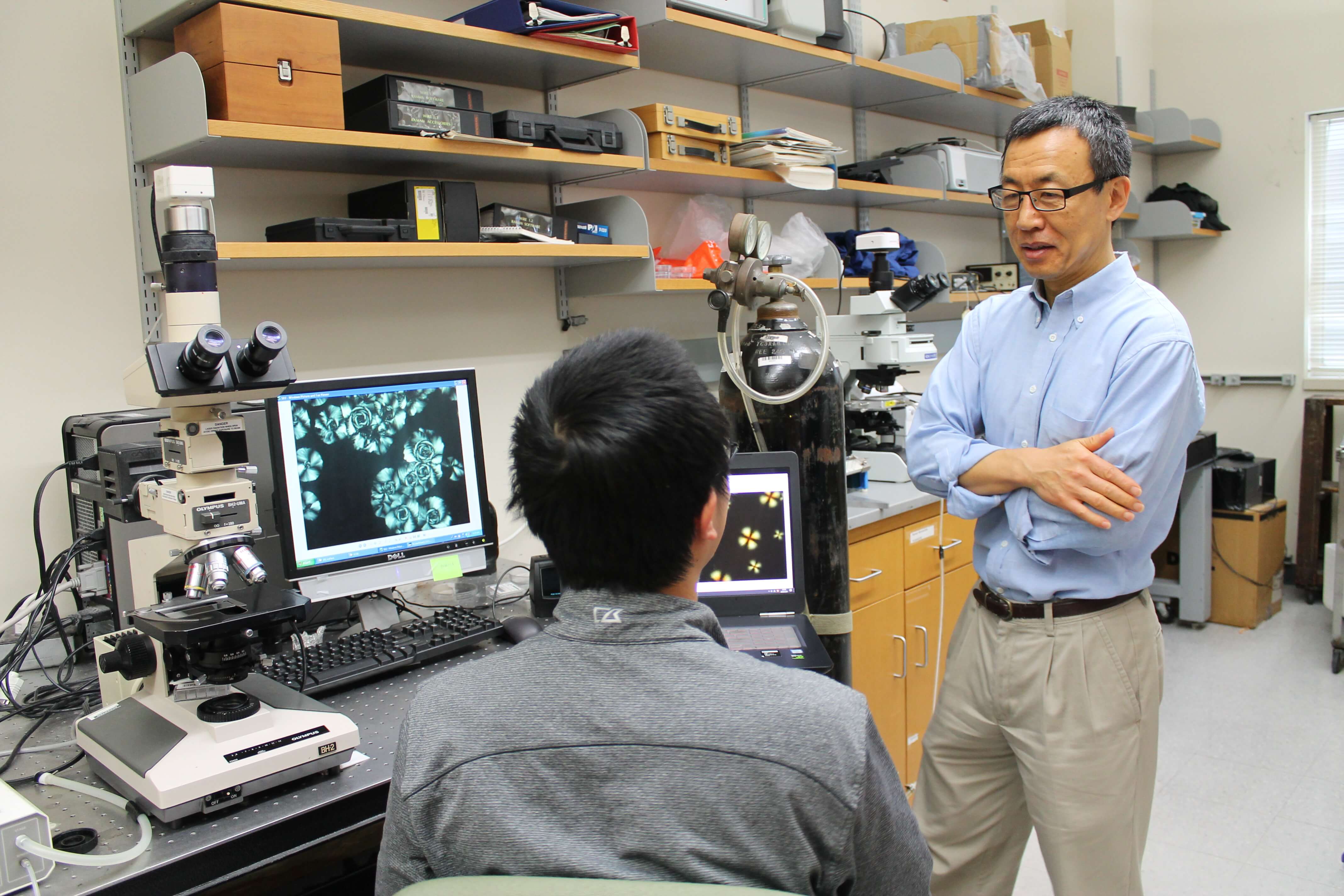
Now UW–Madison is honoring Bugni’s research accomplishments with a Vilas Faculty Mid-Career Investigator Award — a prestigious honor that recognizes his exceptional scholarly productivity, significant contributions, and strong promise for continued achievement. The award is designated for outstanding faculty members who have 10 to 20 years in the field.
School of Pharmacy Professor of Pharmaceutical Sciences Lian Yu is also being honored with a Vilas Distinguished Achievement Professorship, recognizing his long career marked by exceptional scholarship, research, teaching, and service. The Yu Lab explores the molecular structures of pharmaceutical materials and organic solids used in electronic devices, specifically amorphous and crystalline forms of the same substance. This work creates new opportunities for materials engineering, including low-cost drug formulations with better stability and efficacy.
The annual awards are funded in large part by the Trustees of the William F. Vilas Estate in honor of Vilas, a former UW professor and politician. In addition to recognizing faculty’s accomplishments, the awards provide flexible funding to advance their labs’ work. Bugni plans to use his funding to advance the drug development of the novel class of antibiotics, which had previously been unfunded.
“The Vilas award helps tremendously for this project,” says Bugni, who won Research Forward grants for other projects in 2024 and 2021. “Oftentimes faculty are rotating into new areas at the mid-career point, and these additional funds are super helpful.”
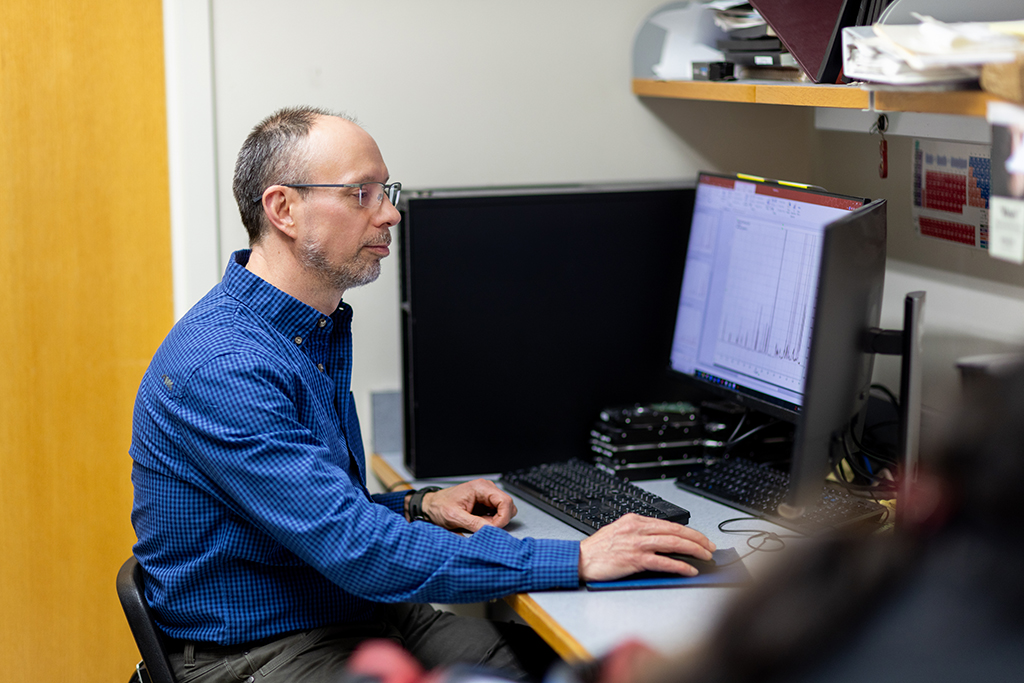
Bugni, who is also the director of UW’s Small Molecule Screening Facility, has long been fascinated by the potential of marine natural products as a source of small molecules for drug discovery.
“Most of our antibiotics have actually come from soil bacteria,” Bugni notes. “From the terrestrial side, it’s estimated that you need to screen about 100,000 to 1 million strains to find a new antibiotic. We’re studying distantly related organisms in the marine environment, and we’ve had a lot more success than a lot of other labs in the U.S. doing this.”
Most recently, Douglas Braun, a senior research specialist in Bugni’s lab, discovered an interesting marine Mycobacterium that appeared to enhance growth of the bacteria the lab uses for drug study. The lab screened 270 marine strains to determine whether they induced antibiotic activity and discovered that many are producing novel antibiotics.
“It’s really remarkable,” Bugni says. “This is probably going to end up being the biggest discovery in our lab.”
After more than 16 years at the UW–Madison School of Pharmacy, Bugni says his greatest pride is mentoring graduate students as they grow as scientists.
“All the big discoveries from the lab — I have a part in it, obviously — but it’s typically me giving somebody in the lab a little bit of space to explore their own intellectual curiosities,” he says. “This latest antibiotic work is a great example. A graduate student named Chris Roberts came into the lab, he learned about the Mycobacterium and wanted to study it for his PhD. And it’s a completely new area of science. Of course, there are a lot of problems when you do something that nobody else has done, and graduate students are still learning. Therefore, it was challenging, but then all of a sudden, it’s like a light switch, and everything he did just worked beautifully.”
“We’ve not only discovered a new class of antibiotic, but we can now use genomics to find other members of this new class of antibiotics that nobody has looked at.”
–Tim Bugni
While the research is still in early stages, Bugni is optimistic that it could lead to other promising research avenues.
“We’ve not only discovered a new class of antibiotic, but we can now use genomics to find other members of this new class of antibiotics that nobody has looked at,” he says.
UW–Madison researchers, including School of Pharmacy Professor Betty Chewning, are developing culturally sensitive tools to empower Hmong and other caregivers.
The School of Pharmacy’s new faculty workgroup on AI explores how the new tech fits into practice, research, and education.