School of Pharmacy Assistant Professor Heather Barkholtz and her collaborators study impairment in drivers who use alcohol and THC
After being dosed with delta-9 THC, a research participant climbed into a driving simulator on the University of Wisconsin–Madison campus. When another vehicle in the simulation crossed the center line, the participant froze — then drove directly into the other car in a head-on crash.
Afterward, Assistant Professor of Pharmaceutical Sciences Heather Barkholtz asked, “How did it go?”
“Pretty good!” the participant reported.
That made Barkholtz wonder whether substances like THC and alcohol impair a driver’s ability to even recognize that they’re impaired, and what that means for public health messaging that typically urges drivers to “drive sober.”
“If they’re not accurately understanding how impaired they are because they’re impaired, then how are we expecting them to make a good choice?”
—Heather Barkholtz
“If they’re not accurately understanding how impaired they are because they’re impaired, then how are we expecting them to make a good choice?” she asks.
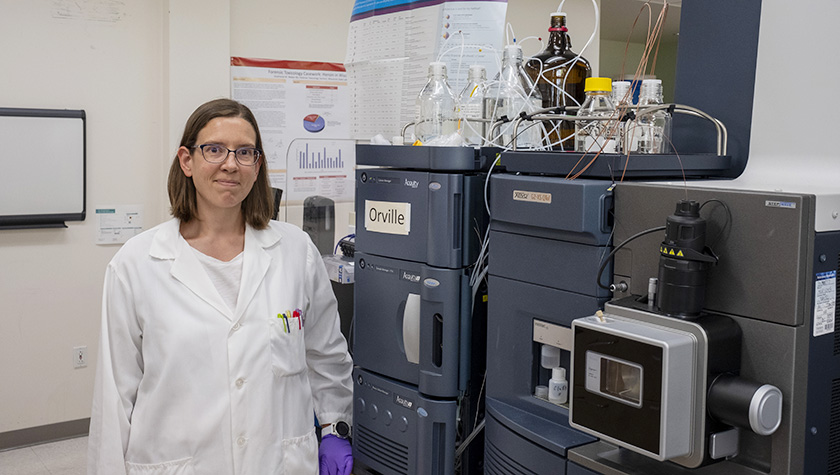
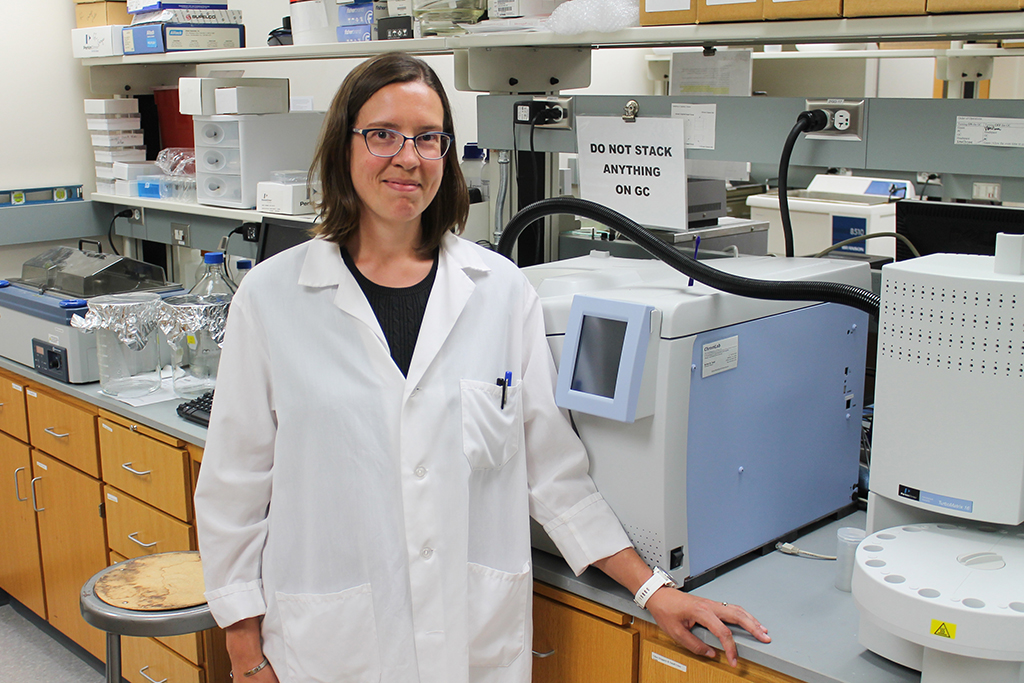
Barkholtz is a forensic toxicologist who has a joint appointment with the UW–Madison School of Pharmacy and the Wisconsin State Laboratory of Hygiene (WSLH), the state’s public health laboratory that processes samples from impaired drivers statewide. Her latest research projects have critical implications for road safety: a clinical trial to validate a tool for measuring driver impairment, and a study on the effects of THC on driver performance.
What she learns could save lives: Impaired drivers are involved in more than 7,000 crashes in Wisconsin each year, including about one in three fatal crashes, according to the Wisconsin Department of Transportation.
Developing tools for assessing impairment
To understand the risks of driving under the influence, researchers first need good measures of impairment. Barkholtz is working to validate DRIVESC, a driving simulation used in other countries to assess drivers’ fitness after medical incidents. DRIVESC measures drivers’ attention, response time, and working memory — all factors that could be impacted by substance use.
For the DRIVESC pilot study, Barkholtz partnered with the Wisconsin Department of Transportation’s Chemical Testing Section, which helps train law enforcement officers on how to conduct breath alcohol testing and what alcohol impairment looks like at the roadside. As part of that training, officers are dosed with alcohol, and Barkholtz’s team used the driving simulation to test their impairment.

“We like to build bridges with our colleagues across the state, and so we’re really excited to work alongside that group,” she says.
The DRIVESC study initially focused on validating the tool to accurately detect alcohol impairment, which has a well-established, straightforward pharmacology.
“The hope is if we can validate these tools to alcohol, then we could potentially use the tools for other psychoactive substances,” she explains.
Barkholtz plans to compare the pilot study’s results with alcohol to her other research on THC impairment.
“We have this model for alcohol, and nobody who’s above a 0.08 blood alcohol concentration is allowed to drive. And so there’s a strong desire from a policy perspective to apply cannabis to that model,” she says. “Unfortunately, the way that cannabis works and how long it stays in your body is not as straightforward. A lot of things from the alcohol model don’t translate, but we’re hoping that some do.”
Understanding the risks drivers take
Barkholtz also used the driving simulator, housed in the Wisconsin Traffic Operations and Safety Lab in the College of Engineering, for a study last year that tested drivers’ skills after being given a placebo, delta-8 THC, or delta-9 THC, compounded and dosed through the School’s Zeeh Pharmaceutical Experiment Station. That study — done in collaboration with Professor of Pharmacy Paul Hutson, director of the UW Transdisciplinary Center for Research in Psychoactive Substances — built on her earlier research on THC.
The THC driving study revealed a key finding: Impaired individuals poorly perceive their own level of impairment and risk. While individuals might recognize that they need to stay off the roads during the intense phase of their initial high, they might not realize they’re still impaired as time goes on.
“I suspect that is a period of much greater risk of engaging in a safety-sensitive task, like driving a vehicle, when you feel like you’ve returned to baseline, but you really haven’t,” she says. “And that may be a very important space for public health messaging and how we’re educating people.”
Understanding alcohol and THC together
For the next phase of her research, Barkholtz plans to explore the combination of alcohol and THC, which are the top two substances, respectively, found in impaired drivers in Wisconsin. Impaired drivers often use both substances together, a potentially higher-risk combination, Barkholtz notes.
“It may be a situation where one plus one equals more than two,” she says. “Is it that you’re much more impaired than if you had consumed them separately, or is it that you’re impaired for much longer? We don’t really know the answers to those questions.”
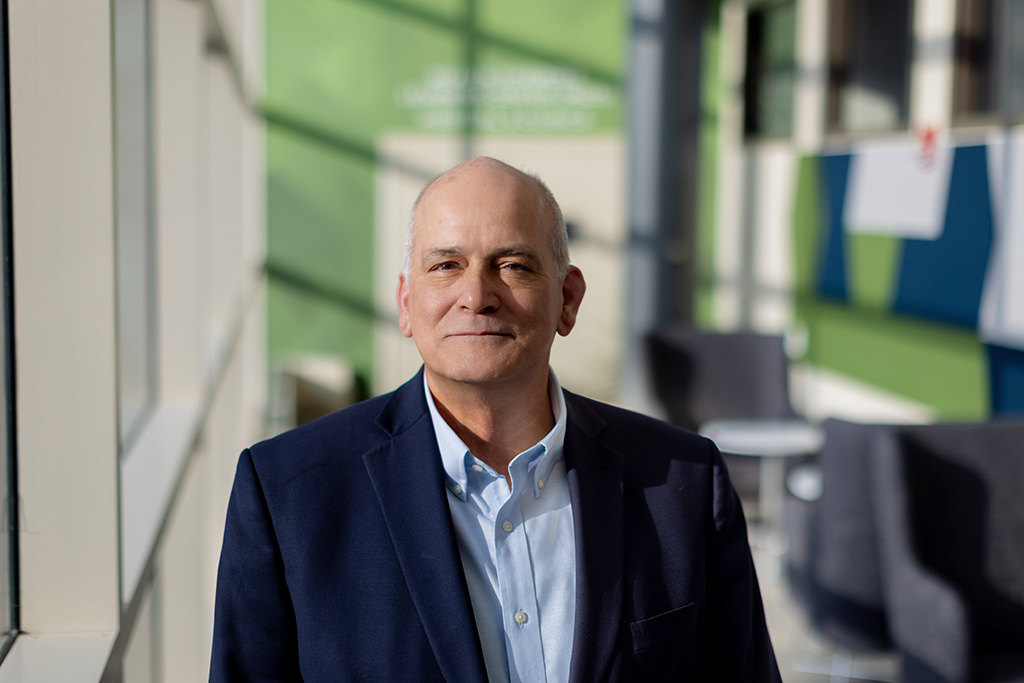
To study that aspect, Barkholtz is teaming up with David Leinweber, an assistant professor and addiction medicine researcher in the UW Department of Family Medicine and Community Health, who also collaborated on the THC pilot project.
“An understanding of pharmacokinetics and pharmacodynamics is essential to understanding substances such as delta-9 or delta-8,” Leinweber says. “Without this fundamental knowledge, our ability to develop and implement novel treatments is limited.”
But conducting this research takes significant resources. Despite the growing availability of THC products, researchers face steep regulatory and financial hurdles. For example, it can cost many thousands of dollars for researchers to acquire drugs that are compliant with study guidelines from the U.S. Food and Drug Administration, while the same amount of THC might go for $60 down the street.
Barkholtz and Leinweber hope to secure federal funding to advance their work, but in the meantime, the UW Institute for Clinical and Translational Research funded the THC pilot project — a critical step to show that a larger study is feasible.
“They were amazing,” Barkholtz says. “Without them, none of this would be happening. But we need funding from the National Institutes of Health or another federal partner to take this work to the next level.”
This work is funded by NIH/NCATS through CTSA award UL1TR002373 to the UW Institute for Clinical and Translational Research. Barkholtz received mentored professional development through the University of Wisconsin-Madison STRIDE program. Funding for STRIDE was provided by the UW School of Medicine and Public Health from the Wisconsin Partnership Program (Grant ID #5132) through a grant to the UW Institute for Clinical and Translational Research. The UW Institute for Clinical and Translational Research also receives funding from NIH-NCATS Clinical and Translational Science Award (CTSA) 1UL1TR002373.