The School of Pharmacy’s new faculty workgroup on AI explores how the new tech fits into practice, research, and education
By Archer Parquette
Imagine a pharmacist cleared of busywork — using artificial intelligence to easily find relevant information in a patient chart or to complete documentation that otherwise would have bogged them down — and taking that newfound time to focus on patient care. On the flip side, imagine a pharmacist using an unreliable AI to make a clinical recommendation that’s ultimately incorrect.
Both are real possibilities. Right now, the health care industry is on the edge of a frontier in AI. That’s why the University of Wisconsin–Madison School of Pharmacy launched a new faculty workgroup on AI charged with ensuring the School gets ahead of the questions plaguing the industry: How can we prepare students for rapid technological advancement? What are the potential dangers, and how can we avoid them?
“The question isn’t whether AI will change pharmacy. It’s whether our graduates will be the ones shaping that change. That’s what we’re here to make sure of.”
—Ed Portillo
“This artificial intelligence space is going to define health care over the next decade,” says Edward Portillo (PharmD ’14) associate professor of pharmacy and associate dean for advancement. “So how are we, as a school, graduating the future alumni who will be drivers in this technology — people who are innovating and using technology to improve care for patients?”
Asking big questions
The workgroup — which includes a dozen faculty and staff representing practice, research, education, information technology, and assessment — considering the use of AI in education and the use of AI in clinical and research settings.
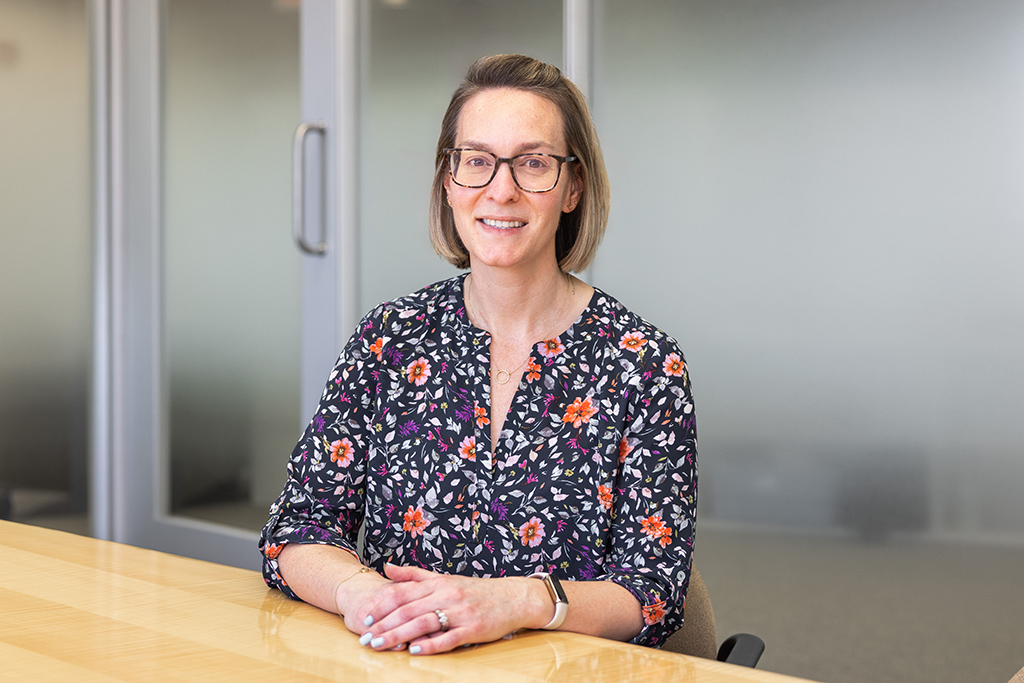
“It’s a substantial charge for a workgroup,” says interim group co-chair Kate Rotzenberg (PharmD ’07), teaching associate professor in the Clinical Practice, Innovation, and Research Division. “We have a cross-section of people who are looking at this from many perspectives and from many different types of education.”
As AI has broad implications, that cross-section is necessary. Clinical practice faculty bring perspectives on how AI is already reshaping pharmacist workflows and patient care. Researchers are evaluating AI’s implications for drug discovery and data analysis. Education faculty are examining what AI skills students should be taught, and what AI uses are acceptable in the classroom. And IT and assessment staff bring expertise in implementation, policy, and institutional readiness.
Together, the workgroup is working toward recommendations to present to the School that may touch on curriculum, academic policy, research, and more. Throughout the year, the workgroup will continue gathering input and building recommendations.
“Our alumni are on the cutting edge of this technology,” says Rotzenberg. “We’ve been gathering their input about where this is going and how it will affect pharmacy in the future.”
That external perspective — through a unique collaboration with the School’s Advancement team, led by Portillo — is central to the workgroup’s mission. Joel Jones (PharmD ’07), vice president of clinical therapeutics and informatics and chief safety officer at Epic, recently joined the School of Pharmacy’s advisory Board of Visitors, bringing a wealth of knowledge about how AI is already being woven into the daily workflow of pharmacists and what’s coming next. He’s participating with the workgroup as an external member, lending his expertise to help align the School’s efforts with the realities of practice.
“That’s the first step in identifying these core competencies for our students,” says Rotzenberg.
AI is already a valuable tool
Tim Bugni, professor of pharmaceutical sciences, director of UW’s Small Molecule Screening Facility (SMSF), and workgroup member, has already seen effective AI and machine learning use in his lab and at the SMSF. The SMSF works in drug discovery, with a goal of identifying new small molecules that inhibit disease targets.
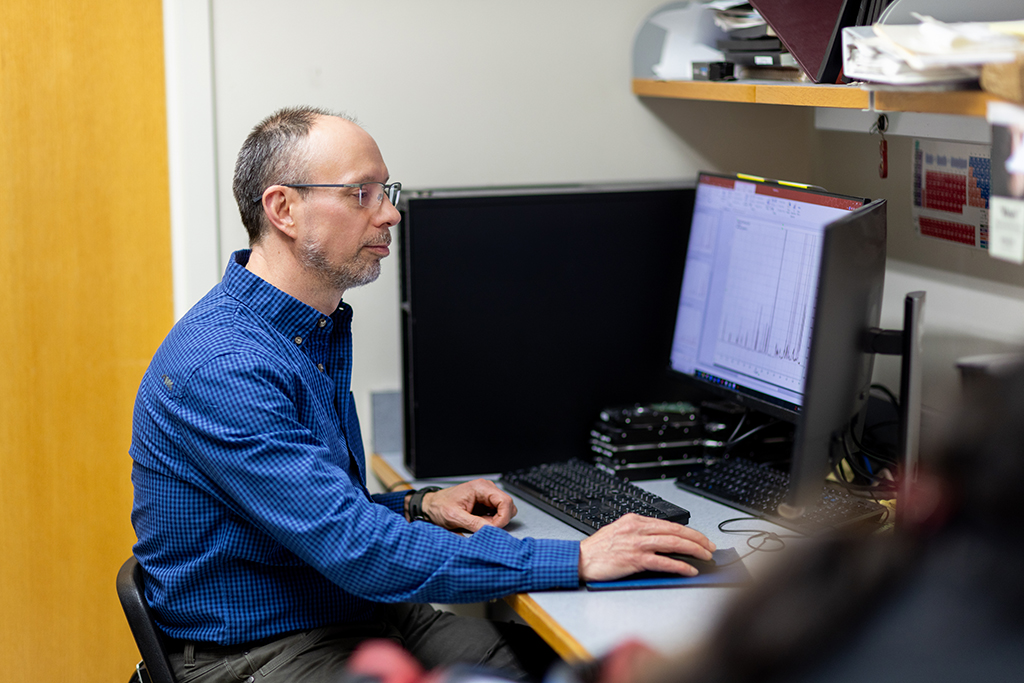
Historically, a researcher would screen 100,000 to 500,000 compounds to find activity in a particular bioassay, such as a cancer cell. Today, Bugni says, AI and machine learning methods can predict molecules that are going to be active. Using that predictive power, a researcher can screen a billion compounds virtually, determine which ones can be accessed, buy and test them, and find the subset that are active — streamlining drug discovery.
“There’s a real growth opportunity with AI use in the Small Molecule Screening Facility,” Bugni says. “I would like to see us reach a point where we can broadly provide AI drug discovery resources for the entire campus.”
Beth Janetski, the School’s assistant dean for assessment and academic planning, brings her own experience with machine learning, a subset of AI, to the workgroup. In her research, she’s often faced with incomplete data sets. In the past, that would mean discarding an entire set, but now machine learning can run a statistical analysis that will input usable data.
“If you use it carefully and with enough caution and concern, you can generate reasonable data to fill in those gaps within your data set,” Janetski says.
The importance of caution
While Janetski has seen the value of certain machine learning applications, she is also “cautious to use AI.” That’s a perspective the workgroup encourages. While much of the workgroup’s charge is learning ways AI can improve pharmacy practice and research, it is also determining guard rails and identifying areas to practice necessary restraint.
“I approach all of this with extreme caution,” Janetski says. She cites studies that have demonstrated AI’s bias when used to assist in grading.
Assistant Professor of Pharmacy Paula Voorheis’ research, focused on human-centered design, is especially valuable in evaluating those concerns.
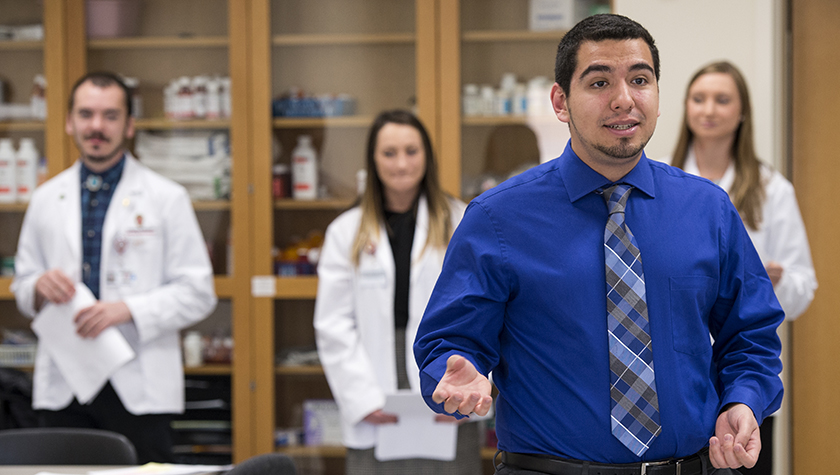
“We want to make sure AI tools are developed in a way that allows humans to work more efficiently — that the tools are designed to help us rather than replace what we already do,” says Voorheis, a workgroup member. “I work with developers to make sure what they’re doing centers people.”
She uses behavioral science to better understand how workflows could be improved with AI, while “making sure the way we teach and deploy those tools still keeps humans at the center of health care, rather than AI itself.”
She sees a lot of promise in, for example, patient communication.
“Take radiology for example,” she says. “Sometimes when a radiologist writes a report, it makes sense to other clinicians, but it might not make sense to the patient or it could be alarming for them. AI can take the report and summarize it in clean, accessible language.”
The workgroup is in its early stages, but every member is focused on the road ahead.
“There are many large conversations to be had,” Voorheis says. “Over the next five, ten years, AI is going to continue to explode, and we need to make sure that we remain conscious of every way it’s being applied to education and to health care.”
Portillo sees the workgroup’s work as inseparable from the School’s broader mission.
“The question isn’t whether AI will change pharmacy,” he says. “It’s whether our graduates will be the ones shaping that change. That’s what we’re here to make sure of.”