School of Pharmacy Professor Mary Hayney and her team are working to understand vaccine response in immunosuppressed patients
By Nicole Sweeney Etter
Vaccines prevent disease, and yet some of the most medically vulnerable people — immunosuppressed patients, a population that includes about 10 million Americans — are often excluded from vaccine trials. To address the research gap, University of Wisconsin–Madison School of Pharmacy Professor Mary Hayney and her collaborators are working to discover how to optimize vaccine use for immunosuppressed people, including patients with inflammatory bowel disease (IBD) and organ transplant recipients.
“They’re essentially an excluded population in vaccine licensing studies, so we don’t know what their vaccine response is,” Hayney says. “They may be more at risk of complications of vaccine-preventable diseases, and they may also be at higher risk of an insufficient immune response after vaccination.”
“Outside of pasteurization of milk and chlorination of water, vaccines have done more to lengthen life than any other intervention that we have.”
—Mary Hayney
Hayney, who has studied vaccine optimization for more than 30 years, was drawn to the topic because of its potential for high impact. Before vaccines, nearly one in five American children died before age 5, she notes.
“Preventing disease will lengthen life,” she says. “Outside of pasteurization of milk and chlorination of water, vaccines have done more to lengthen life than any other intervention that we have.”
Hayney’s recent work has focused on measuring the durability and vigor of immune responses to the zoster (shingles), varicella (chickenpox), and measles vaccines in immunosuppressed patients. She works closely with Freddy Caldera, a gastroenterologist and associate professor in the UW School of Medicine and Public Health. “We’ve been collaborating for more than 10 years, and we’ve been quite a productive team,” she says.
Their current studies are funded by the Yehle Family Fund, but other funding for vaccine research is scarce because of the federal funding environment, which is also spurring research cutbacks at vaccine manufacturers. While her current work is hands-on, Hayney plans to pivot to analyzing large medical record databases, which is less expensive and allows researchers to compare differences across a larger population of immunocompromised patients.
“We can use medical records to measure the incidents of hospitalization following a specific infection, and we can see whether vaccines protect against hospitalization and ICU admission,” she says.
Here’s a look at the inner workings of the Hayney Lab.
Research specialist Sue McCrone (left) and Hayney choose samples for an enzyme-linked immunospot (ELISPOT) assay, a commonly used technique to measure cell-mediated immunity.
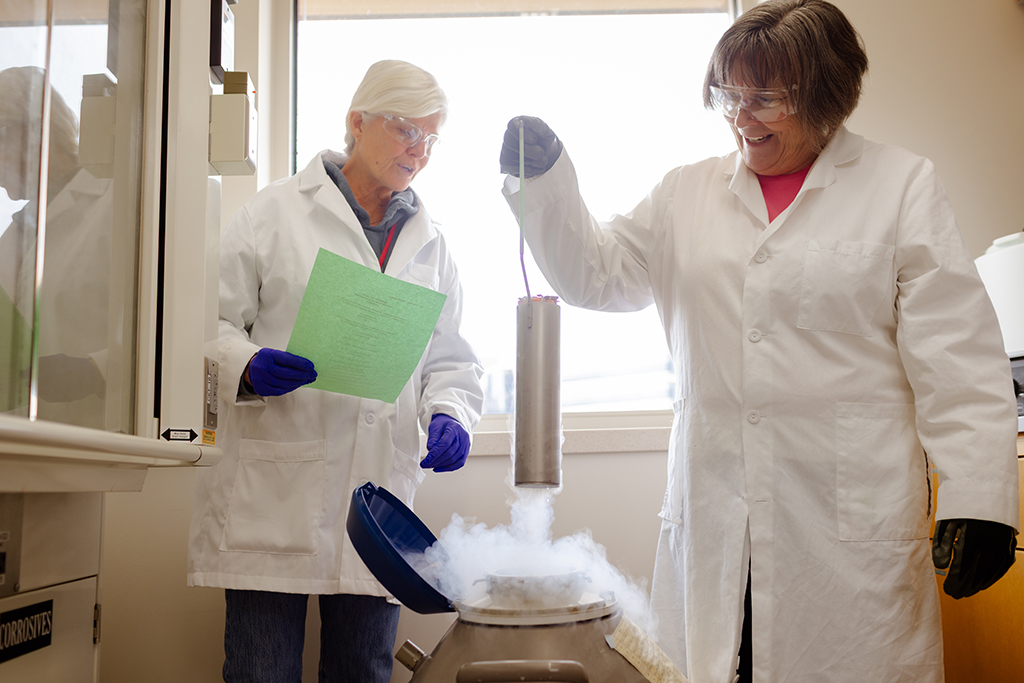
The lymphocyte samples are preserved in liquid nitrogen until they’re ready for use, which could be a few months to a couple of years, depending on the study.
“This is a strategy to preserve live cells,” Hayney says. “When we freeze these lymphocytes, we can thaw them and measure their biological functions.”
Below: Research specialist Kellen Lund pulls samples of stored lymphocytes previously collected from patients with IBD.


McCrone uses a microscope to count cells to ensure the lab’s samples of isolated lymphocytes are consistent for the ELISPOT assay.
“We may harvest the same amount of blood from everybody, but some cells might be fragile, and not everybody will have the same number of lymphocytes to start with,” Hayney explains. “If the samples aren't consistent, we can’t accurately compare immune responses across patients.”
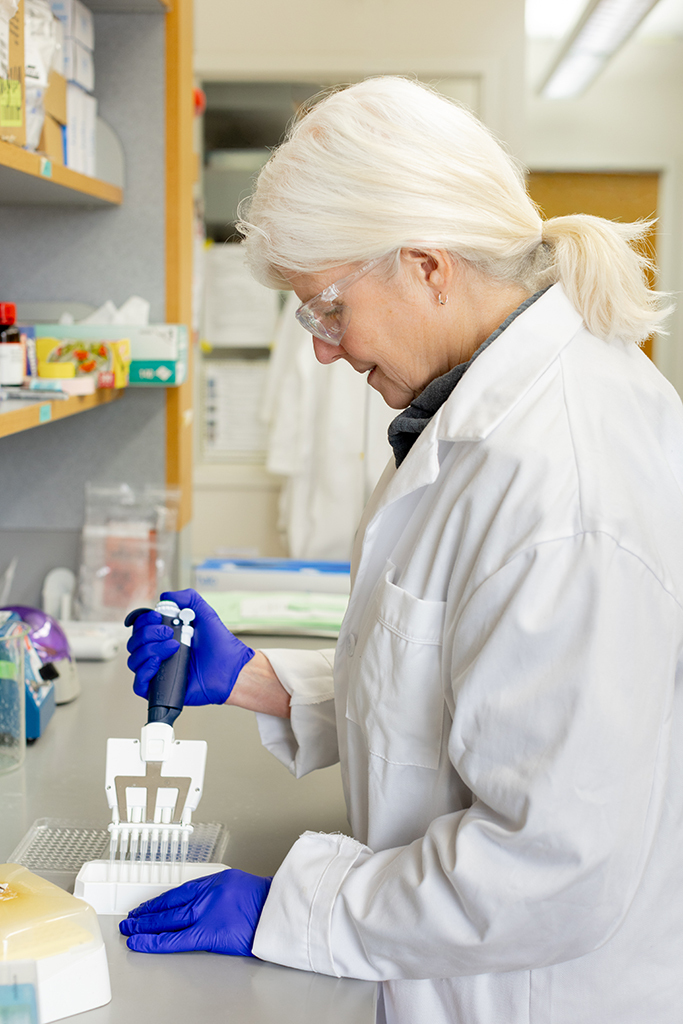
McCrone pipettes on a 96-well plate for a varicella antibody study. The Hayney Lab has used antibodies to study the durability of the chickenpox vaccine response in immunosuppressed patients compared with those who have had a chickenpox infection. While it’s well known that the varicella vaccine produces fewer antibodies than an actual infection — yet remains 98% effective after two doses — that has not been established in an immunosuppressed population, such as patients with IBD.
“We’re still analyzing the data,” Hayney said, “but I think we’re going to see that while the vaccine induces lower antibody response compared to people who have had infection, they still have measurable antibodies that can help defend against infection or complications that can arise from infection.”
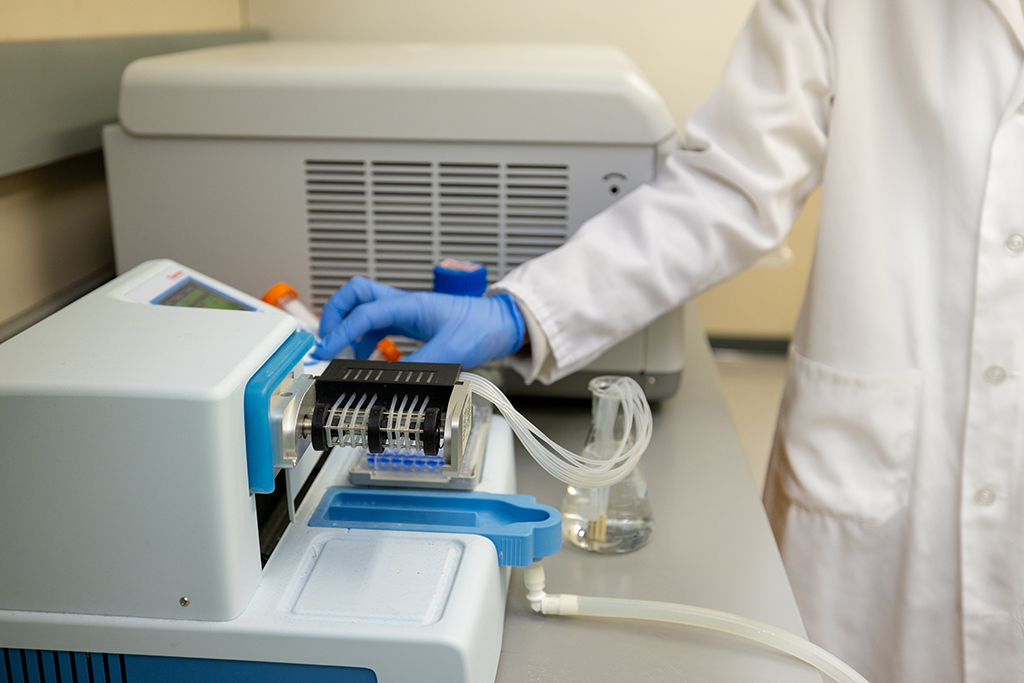
The plate washer is a basic but valued piece of lab equipment that is often used up to 10 times per assay. It can wash a 96-well plate in under a minute.
“We have to wash away the buffer we use to grow the cells in, and then we stain the cells so that we can see and measure the response,” Hayney says. “The washer dramatically increases the efficiency of the lab because it is way faster than any person could do it.”

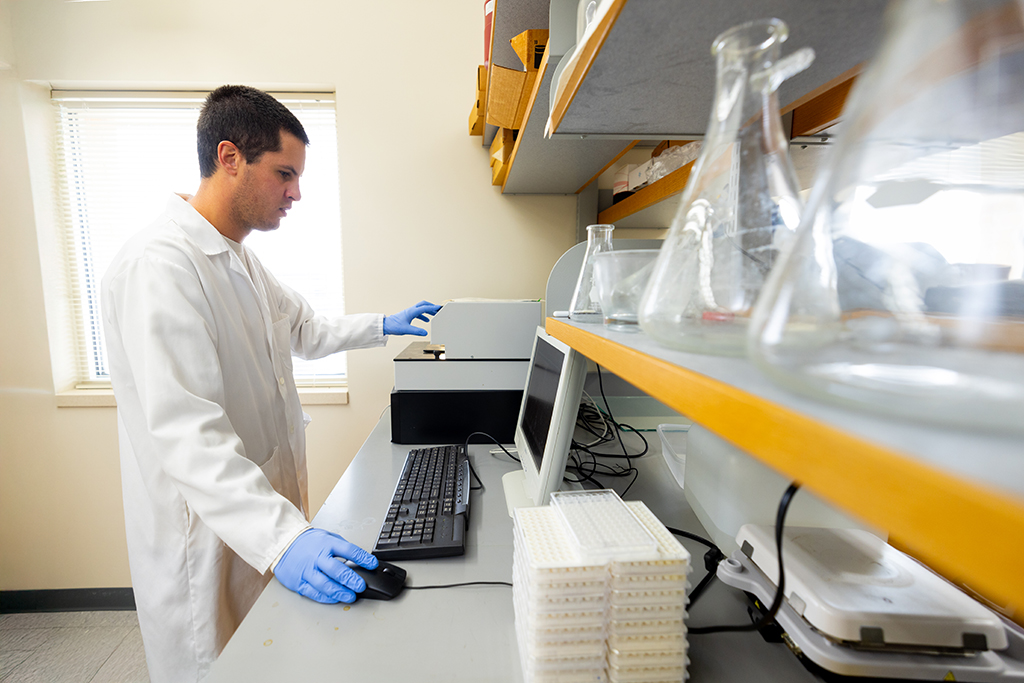
Lund and Hayney read an ELISPOT assay, examining the spots of cytokine secretion.
“Immunosuppression can target cell-mediated immunity, and it’s harder to measure than antibody-mediated immunity,” Hayney says. “So we use this assay, and we stimulate lymphocytes from a vaccinated person with varicella zoster, the virus that causes shingles, and measure the vigor of their immune response.”
In a population of lymphocytes from a vaccinated person, some will make an immune response to the specific antigen.
“Our laboratory can measure how many lymphocytes make the antigen-specific response by incubating them with that antigen — varicella zoster in this case — typically overnight,” Hayney explains. “The cytokine will be bound to the antibody-coated membrane in the bottom of the plate. The bound cytokine is stained so that it makes a spot. We can count the spots and know how many cells respond to the antigen.”
In this study, Hayney’s lab has found that the immune response is maintained over time, which is promising.
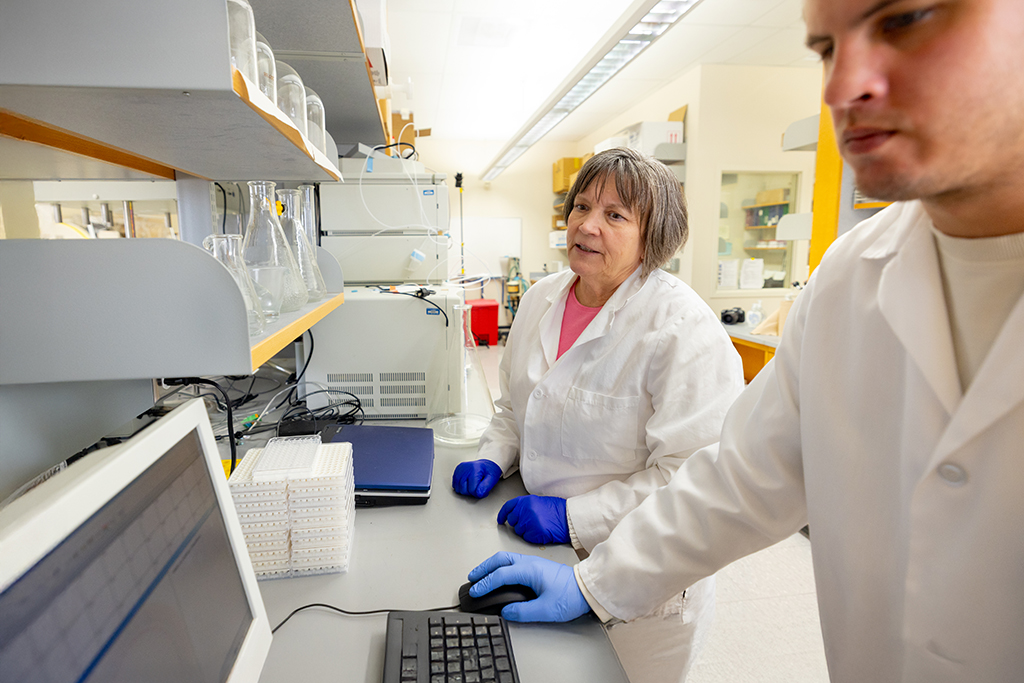
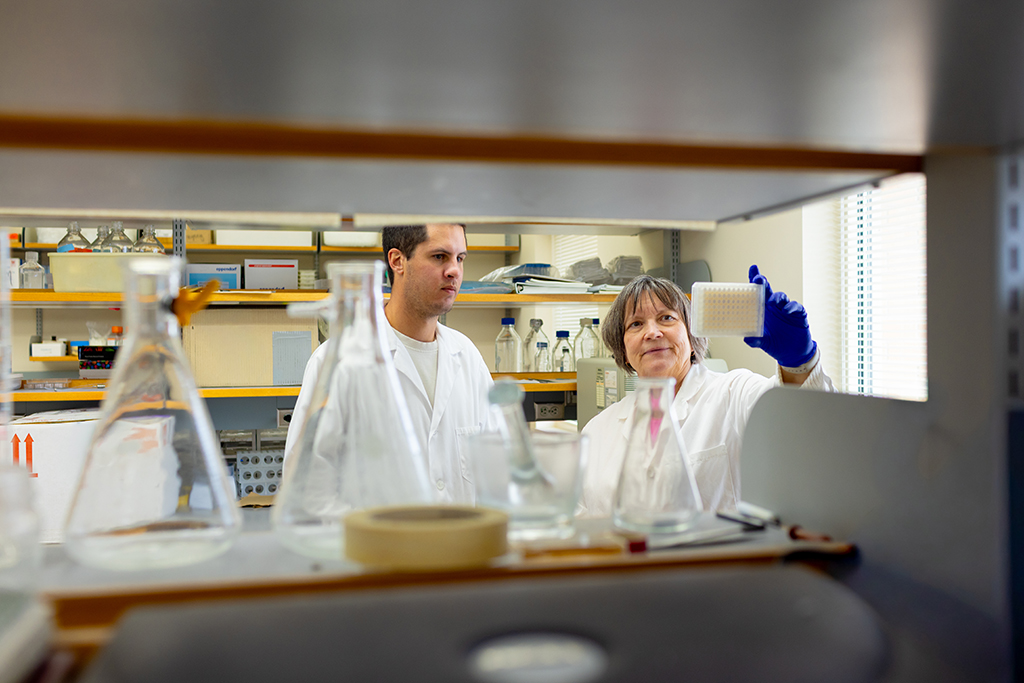
Hayney and Lund examine an ELISPOT plate.
“We can see the dots made by individual response cells in the bottom of those wells, but we can’t count them,” Hayney says. “So we have a machine that counts them much more reliably based on pixels and size. However, I can see the patterns. For instance, the positive controls will have very dark wells — they’ll have a lot of responders — and the negative controls should have very few spots. And so I always look at it because I’m curious: How well did this plate work?”
For another study, Hayney’s lab is comparing two assays to measure antibody response after the measles vaccine.
“The measles antibody assays are designed to measure the immune response to infection, not vaccination, and so we’re comparing a very sensitive assay that’s not FDA licensed yet,” she says. “The results show that the more sensitive assay measures vaccine antibody response better. The other thing that is really important is that these vaccinated people have antibodies that we can measure, even though it might be more than 50 years since they’ve been vaccinated.”
The current measles outbreaks in the U.S. underscore the importance of research on vaccine responses, Hayney notes. The research shows that even those who are currently immunosuppressed likely remain protected from measles if they have been immunized.
“Studying vaccine responses in immunosuppressed people is important as the results can be almost immediately applied to patient care,” she says. “In fact, our work is used to shape preventive care guidelines. Our research shows that vaccines work.”