
Alumni Kristina Heimerl, Connie Vo, and Jim Langley validate a new tool that empowers pharmacists to help patients manage IBD
By Jennifer LW Fink
About 3 million Americans are living with inflammatory bowel disease (IBD), including Crohn’s disease and ulcerative colitis. It’s a chronic condition often managed with specialty medications, but successful disease management requires careful monitoring of patients’ health and readjustment of the treatment plan as necessary.
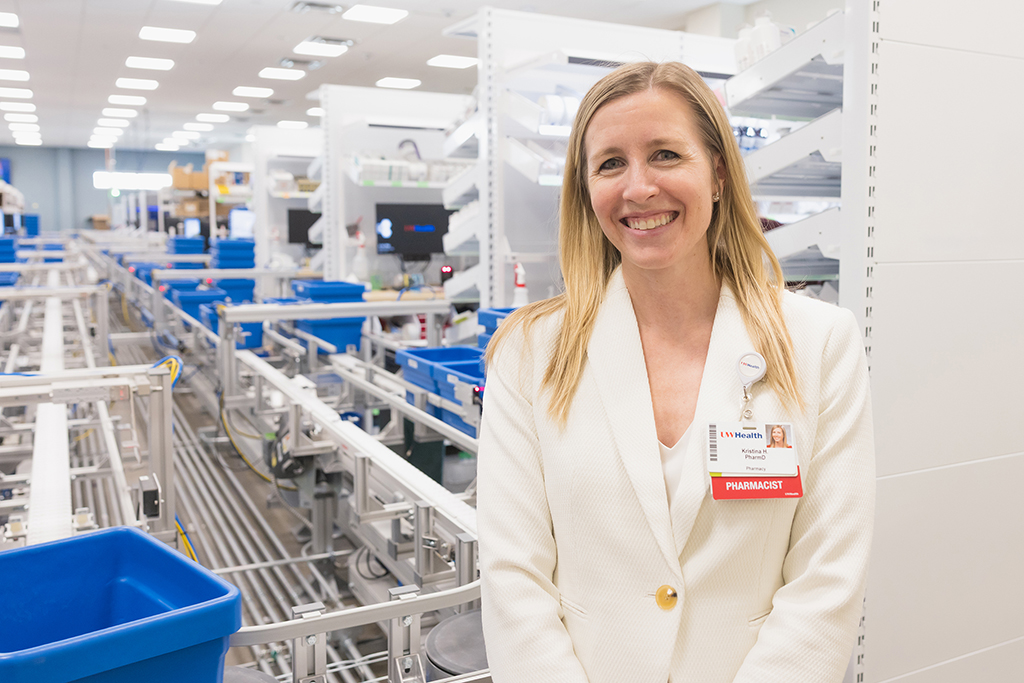
Unfortunately, due to patient volume and limited clinic access, individuals can go a full year — or more — between appointments with their gastroenterologist, says Kristina Heimerl (PharmD ’14), a clinical pharmacist and ambulatory care residency director at UW Health.
“Our specialty pharmacy has really been trying to bridge the gap in monitoring patients,” says Heimerl.
“Our specialty pharmacy has really been trying to bridge the gap in monitoring patients.”
—Kristina Heimerl
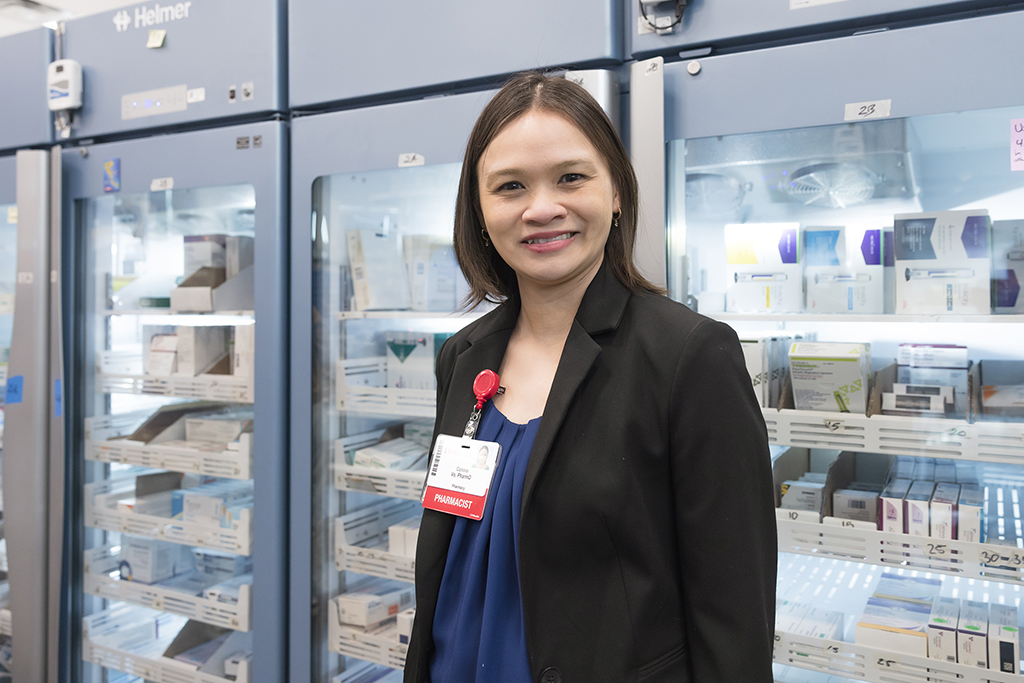
Alongside fellow University of Wisconsin–Madison School of Pharmacy alums Connie Vo (PharmD ’11), Jim Langley (MS ’17), Megan Kuik (PharmD ’22), Cidnee Waller (PharmD ’17) and colleague Jaynika Patel at UW Health, Heimerl has been working to validate a new tool — the Gastrointestinal Metric (GIM) score — to help patients monitor their IBD.
“Pharmacists are clinical partners in care, not just medication dispensers,” says Patel, a UW Health pharmacist who participated in the validation effort. “I was really drawn to this project because it addresses a clear gap in care using a pharmacist-led tool that can be implemented in real time.”
Closing the care gap
In 2019, a UW Health specialty pharmacy resident launched a project to create an IBD assessment tool, focusing on inflammatory bowel disease because it was the highest-volume condition managed by the specialty pharmacy at that time.

Existing tools were designed for gastroenterologists and included assessments that pharmacists could not perform. To create an alternative tailored to pharmacists — often the most accessible healthcare providers — the UW Health team consulted a variety of different stakeholders, including pharmacists, providers, and payers, to determine what to include in a targeted, easy-to-administer assessment.
The result was the GIM score, a tool that uses a simple scoring method to assess seven different disease variables (general well-being, abdominal pain, bowel frequency, bloody stools, resolution of symptom attempts, next dose awareness, and work/school productivity) and two medication efficacy variables (missed doses/adherence and adverse effects) to identify stable or unstable disease control.
Over the next five years, Heimerl, Vo, Langley, and the specialty pharmacy team incorporated the tool into clinical practice and fine-tuned it for clarity and convenience.
“We wanted to get it validated, but we were busy, growing, and working through the COVID pandemic,” says Vo, specialty pharmacy manager at UW Health. “An ASHP grant gave us the opportunity to finally show the accuracy and utility of the GIM score.”
From practice innovation to prospective validation
In 2024, the ASHP Foundation, the philanthropic arm of the American Society of Health System Pharmacists, offered four grants for specialty pharmacy projects focused on managing care for patients with inflammatory bowel disease. It was a perfect opportunity.
Heimerl filled out a grant application and won a $10,000 grant, which supported the prospective study Heimerl, Patel, and Vo initiated to validate the GIM score. The trio also hired three UW–Madison pharmacy students — Rylee Buchman, Nourhan El-Sanjak, and Hanna Helling — to help with the research.
The research team engaged with specialty pharmacists, gastroenterology physicians and nurses, and informatics experts, who helped design the workflows, including the creation of a “hard stop prescription flag” in the electronic health and pharmacy records that aided in study enrollment and participation.
“If that flag was there, study investigators would complete the GIM score tool with the patient while they were already on the phone, requesting their refill,” Patel says.
Such multi-disciplinary collaboration was key to the success of the study.
“Enrolling patients in a prospective study can be challenging,” Heimerl says. “But because of our partnership, we were able to hit our mark. More than 150 patients enrolled in our study.”
Researchers determined a baseline GIM score for each patient via a phone conversation, within one week of the patient’s scheduled gastroenterology appointment. At their appointment, a GI provider assessed the patient’s disease status using the provider’s standard IBD questionnaire. When possible, researchers also conducted a follow-up GIM score assessment four or eight weeks after patients’ visits with their GI provider depending on their initial GIM score.
The statistical results officially confirmed that the GIM score correlates with the clinic IBD questionnaire, providers’ assessment of stable or unstable IBD, and return-to-clinic intervals. The results also underscored the critical role pharmacists play in disease monitoring.
Importantly, the team developed an accurate cutoff score for stable or unstable disease: a GIM disease activity score of 5 or above indicates unstable disease, while a score less than 5 is indicative of stable disease.
“This tool allows us to intervene as pharmacists, even if they’re not scheduled to see their provider for another six months,” Heimerl says.
She notes that GIM scores have already helped with prior authorizations of specialty drugs.
“We now have supporting documentation we can use to appeal denials and get medicine approved for the patient,” Heimerl says.
Patel says that she has heard “a lot of positive feedback” from patients who appreciate the “one-on-one with a provider.” Although it only takes 5 to 7 minutes to assess a patient’s GIM score, that time allows patients an opportunity to share their concerns and ask questions.
A practice-changing intervention
At present, the UW Health specialty pharmacy team continues to use the GIM score in clinical practice. The researchers are also working with UW Health gastroenterologists to develop standards to detail which steps should be taken when a patient’s GIM score hits a certain level.
The research team also presented their research at the national ASHP Midyear conference and the Wisconsin Pharmacy Residency Conference. They are finalizing their research manuscript and plan to submit it for publication in 2026.
“This tool allows us to intervene as pharmacists, even if they’re not scheduled to see their provider for another six months.”
—Kristina Heimerl
“Our goal is to continue to disseminate the GIM score and have other specialty pharmacies utilize this tool,” Heimerl says.
As pharmacy practice continues to evolve, tools like the GIM score demonstrate what’s possible when pharmacists lead innovation in patient monitoring.