At CVS, alum Daryl Fahrner goes beyond the call of duty to automate workflows and enhance patient safety
By Katie Ginder-Vogel
Next to Lambeau Field in Green Bay, Daryl Fahrner (PharmD ’15) runs one of the busiest CVS pharmacy locations in Wisconsin — which means efficiency is essential.
In addition to managing 13 employees, Fahrner is always on the lookout for opportunities to automate workflows, especially with the goal of improving patient safety by reducing medication errors. And his dedication to ingenuity in the name of patient care is not going unnoticed: He earned the region’s Paragon Award for impactful leadership in 2024 and 2025, out of about 170 stores, and he’s been named one of CVS Health’s top five innovators in the entire company several times. In fact, he was honored with CVS’ All-Time Top Innovator Award in 2023.
“Anything we can do to reduce barriers for people getting medications and decrease the strain on pharmacists by streamlining workflow, I’m all for that,” he says. “It drives the profession forward.”
“Anything we can do to reduce barriers for people getting medications and decrease the strain on pharmacists by streamlining workflow, I’m all for that. It drives the profession forward.”
–Daryl Fahrner
Through what he calls his “work hobby,” Fahrner is leveraging automation to eliminate repetitive Medicaid rejections, prevent costly billing errors like unit-of-use mismatches, and streamline third-party processes. And he’s built it into a platform that’s shareable across Wisconsin’s CVS pharmacies — with many automations reaching all of CVS’ 9,000 stores.
“Pharmacy practice has become a goldmine of information we can utilize to try to drive down product loss, simplify third-party authorization, use best practices with billing, and prevent medication errors,” he says. “I find it impactful to be able to contribute to the profession and affect how 100,000 pharmacists and pharmacy technicians are able to work every single day.”
Learning tech skills
When Fahrner started his role at CVS 10 years ago, he didn’t know how to code algorithms or run Structured Query Language (SQL) queries — and he didn’t think he’d ever need to.
“Database analytics didn’t take off in pharmacy until within the last seven or eight years,” he says.
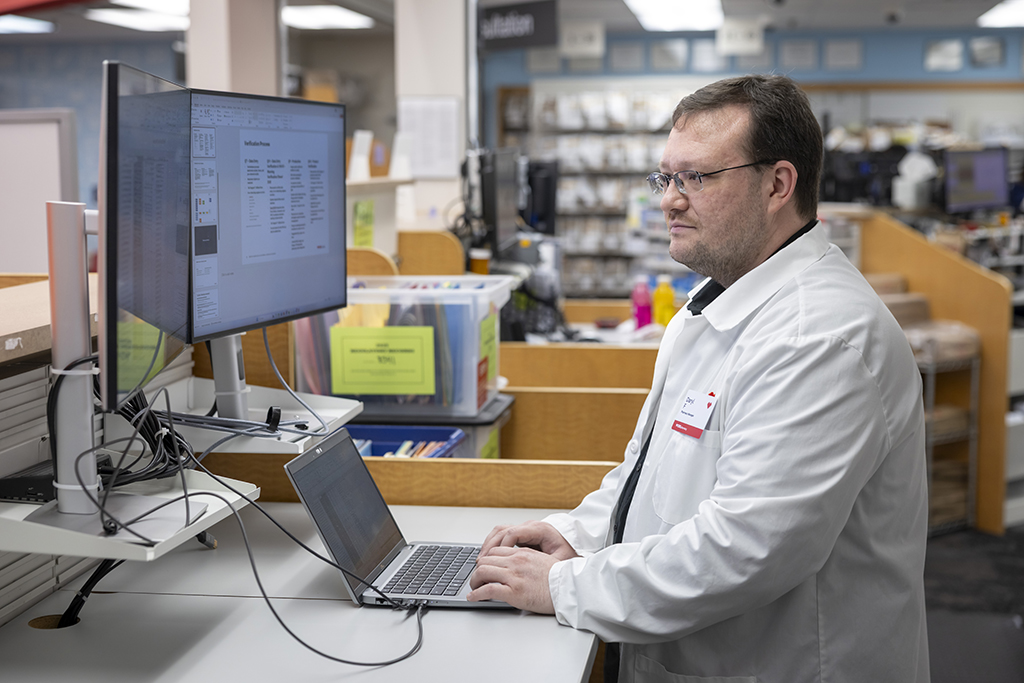
But then he started to see automation opportunities in the software to prevent claims from being submitted missing necessary information, or prescriptions from being dispensed with incorrect billing units, creating errors that had to be manually corrected.
To create solutions, Fahrner started taking on stretch assignments at CVS’ corporate headquarters, including one in verification innovation, where he picked up data analysis skills. During the assignment, he helped build a system for workload sharing, and an error alert system to reduce inventory shrinkage and third-party audit risk.
“I learned how to write SQL queries to identify opportunities and then code rules within a system to deliver it to the entire company,” Fahrner says.
Today, Fahrner spends his spare time testing and providing feedback on technical updates to CVS’s workflow, helping write Alert IQ algorithms, and integrating strategies to reduce third-party audit risk and shrink. He’s used those tools and skills gained to further innovate processes developed right in his Green Bay CVS.
Driving pharmacy forward with data
Fahrner has a particular interest in Wisconsin’s Medicaid workflow, which is often fraught with predictable claim rejections. To help, he set up CVS stores in the state with Forward Health Portal access and built automations to automatically resolve third party rejections, reduce billing errors, decrease confusion with store teams, and handle prior authorization mistakes that often lead to time-consuming rejections.
“My store has the most Medicaid claims of any CVS location in the state, so if I’m running into the same rejections over and over again, it impacts me more than any other store,” he says. “I’ve helped write algorithms to prevent and manage rejections, and we’ve eliminated about 70,000 rejections annually in our stores, which is a huge time savings.”
Fahrner is also developing a training module on Medicaid billing processes and prior authorizations that will be included in the standard learning curriculum for Wisconsin CVS Pharmacy employees.
His most impactful project focused on unit-of-use billing. Each medication package has a National Drug Code (NDC) that identifies exactly how much medicine is in that package. If a prescription is billed incorrectly — for example, charging for incorrect quantities — it creates costly errors.
Fahrner and his team updated the system to include about 11,000 NDCs under an AlertIQ unit-of-use algorithm that alerts teams if a wrong quantity is being billed. This reduced unit-of-use billing errors by 96%, saving the company $11.9 million in 2024 alone. The work continues as new medications and generics are introduced, ensuring the system stays accurate and cost-effective.
In another project, Fahrner wrote algorithms to round up to the next highest multiple of the total package size, to automatically calculate billable quantities on unit-of-use products.
“There are 534 ways a prescriber can send in a quantity, but only one billable unit,” Fahrner explains. “If, for example, a prescriber sends a Lantus insulin pen prescription in as five pens, you can’t bill five pens — you have to bill it in milliliters based on the National Council for Prescription Drug Programs guidelines. Same with reconstitutable antibiotic suspensions — you can’t saw a bottle in half, so you dispense a full bottle every time, but you have to bill it correctly.”
Fahrner keeps a folder next to his workstation of projects he’d like to tackle when he has time, and during downtime or on evenings and weekends, he pivots to those technical projects.
“I look at claims data and metrics from across the entire company to look at trends in errors that we are seeing based on feedback I receive from my peers, then perform a root cause analysis,” he says. “I also do many things to promote patient safety at my own store — mainly physical and tangible elements — but I focus on systems approaches within our IT system to create or influence change.”
‘Be a part of the solution’
Fahrner’s enthusiasm for technology is unflagging.
“Pharmacy is a technology-driven profession, and we have to acknowledge that it will only move forward and faster,” Fahrner says. “We’re doing a lot of cool things at CVS, including AI projects to help with billing issues and to detect if we have the right packages. I gave input and have been pilot testing those projects.”
Fahrner says pharmacists in all practice settings can contribute meaningfully to medication safety and patient care.
“I find it impactful to be able to contribute to the profession and affect how 100,000 pharmacists and pharmacy technicians are able to work every single day.”
–Daryl Fahrner
“If you see a problem, find out why it is occurring, then figure out how frequently it is occurring and present reasonable ideas on how to solve the problem,” he advises. “Offer to be a part of the solution.”
Fahrner keeps his focus on using technical tools to automate mundane tasks to save pharmacists’ time and pharmacies’ money.
“What can I do with the things I’ve learned with data analytics to move everything forward?” he says. “How can I automate my own processes? If there’s something we can do differently to impact the workflow and save teams time, I’m all for that, so we can spend more time having better, more impactful conversations with patients.”