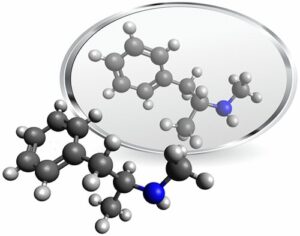
 Methamphetamine remains one of the most frequently encountered drugs in forensic and clinical toxicology, yet standard laboratory testing often reports only “methamphetamine” without distinguishing between its stereoisomers. Methamphetamine exists as two chemically identical but biologically distinct mirror-image forms: dextro-methamphetamine (D-MAMP), a potent central nervous system stimulant widely implicated in substance use and impairment, and levo-methamphetamine (L-MAMP), a less psychoactive isomer that is also found in some over-the-counter nasal decongestants and racemic street products. Despite widespread prevalence and complex patterns of use, there is a significant gap in translational human data on the pharmacology, metabolism, and stereoselective disposition of these enantiomers across forensically relevant biological matrices. This project addresses these gaps by developing enantiomer-specific analytical methods and generating fundamental pharmacological data to improve toxicology interpretations in forensic practice.
Funding Partner

Research Objectives
The primary aims of this project are to:
-
Develop and validate accessible, enantiomer-specific analytical methods for separating and quantifying D- and L-methamphetamine and their metabolites using liquid chromatography–tandem mass spectrometry (LC–MS/MS), enabling greater informational yield from forensic and clinical samples.
-
Characterize the pharmacokinetics and distribution of methamphetamine stereoisomers and key metabolites across multiple human biological matrices (e.g., plasma, whole blood, oral fluid) following controlled administration.
-
Quantify correlations between analyte concentrations across matrices to inform interpretation strategies for impaired driving, workplace testing, and postmortem toxicology.
-
Provide foundational evidence on stereoselective metabolism and behavioral relevance of methamphetamine isomers to enhance forensic and clinical interpretation of toxicology results.
By integrating method development with controlled pharmacological investigation, this work seeks to build the scientific basis for improved interpretation of methamphetamine exposure in diverse forensic contexts.
Significance and Impact
This project addresses several important limitations in current toxicological practice and public safety:
-
Enhanced analytical capability: Many forensic laboratories historically do not differentiate isomers in casework, limiting the specificity of interpretations related to illicit versus legitimate exposures. Method development here enables enantiomer-specific measurement to maximize useful information from existing evidence and workflows.
-
Improved understanding of stereoisomer biology: Little translational data exist on how the two methamphetamine isomers differ in human pharmacokinetics and metabolism, despite clear stereochemical and pharmacodynamic differences documented in prior research. Filling this knowledge gap strengthens the scientific foundation for interpreting toxicology results across clinical, forensic, and legal settings.
-
Relevance to public health and impaired driving: National survey data indicate extensive methamphetamine use and associated impairment risk, including driving under the influence. Clarifying how enantiomer concentrations relate to pharmacological effects can help refine toxicological criteria used in public safety decision-making.
-
Informing policy and legal interpretation: Distinguishing between isomers has direct implications for legal cases where over-the-counter drug use may be misinterpreted as illicit methamphetamine exposure. Providing robust enantiomer-specific evidence enhances fairness and accuracy in criminal and administrative proceedings.
By generating and validating enantiomer-specific data, this research enhances both the scientific rigor and practical relevance of methamphetamine toxicology.
Outputs and Dissemination
Data collection and analysis for this project is ongoing. Projected project outputs include:
-
Validated methamphetamine enantiomer analytical methods compatible with routine forensic toxicology instrumentation and workflows.
-
Pharmacokinetic datasets quantifying D- and L-methamphetamine and metabolite concentrations across matrices following controlled dosing.
-
Peer-reviewed publications and conference presentations communicating key methodological insights and translational findings to forensic, clinical, and analytical chemistry communities.
-
Collaborative engagement with forensic laboratories to assess real-world applicability of enantiomer-specific methods and interpretation frameworks.
These outputs provide foundational knowledge and practical tools to support improved forensic toxicology practice, training of new scientists, and the design of future studies on stereoisomer-specific drug effects.
Clinical trial registration
NCT06746831 – Methamphetamine Isomer Pharmacology in Humans