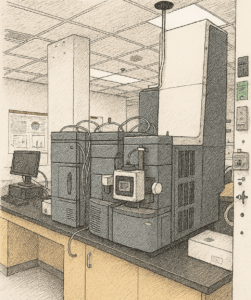
The emergence of novel psychoactive substances (NPSs) presents a persistent challenge for forensic and clinical toxicology: how can laboratories rapidly detect, identify, and characterize compounds that are not included in traditional targeted assay libraries?
This project focuses on the development and validation of data-independent acquisition (DIA) workflows using quadrupole time-of-flight (QTOF) mass spectrometry to support comprehensive detection and characterization of drugs of abuse. The work is designed to address limitations of traditional targeted toxicology methods by enabling broad, high-confidence screening for National Safety Council (NSC) Tier I and Tier II substances, as well as structurally related analogs and metabolites.
By integrating DIA data with molecular networking approaches, this research advances scalable, reproducible strategies for detecting known and emerging psychoactive compounds in complex biological matrices.
Funding Partner

Research Objectives
This project aims to:
-
Develop and validate QTOF-based DIA methods optimized for high-confidence identification of drugs of abuse
-
Establish analytical workflows capable of detecting NSC Tier I and Tier II substances, including opioids, stimulants, sedatives, and emerging psychoactive compounds
-
Evaluate the performance of DIA data for retrospective analysis and unknown identification
-
Apply molecular networking to organize and interpret complex spectral datasets, enabling structural inference beyond targeted compound lists
Together, these efforts support more comprehensive and future-proof toxicological screening strategies.
Significance and Impact
This project advances forensic toxicology by providing a robust framework for wide-scope, non-targeted drug screening that remains analytically rigorous and operationally feasible. Key impacts include:
-
Improved detection of emerging and structurally diverse drugs of abuse
-
Reduced dependence on constantly expanding targeted panels
-
Enhanced capability for retrospective analysis as new substances are identified
-
Alignment with evolving needs in forensic, clinical, and public health laboratories
By combining QTOF-based DIA with molecular networking, this work supports a more adaptive and intelligence-driven approach to toxicological analysis.
Status and Dissemination
Data collection for this project is nearing completion. Work from this project has led to:
-
Development of reproducible molecular networking pipelines integrated with HRMS datasets
-
Case studies demonstrating the discovery of previously unreported or poorly characterized compounds
-
Presentations at analytical and forensic science conferences
-
Peer-reviewed publications in open-access and domain-specific journals